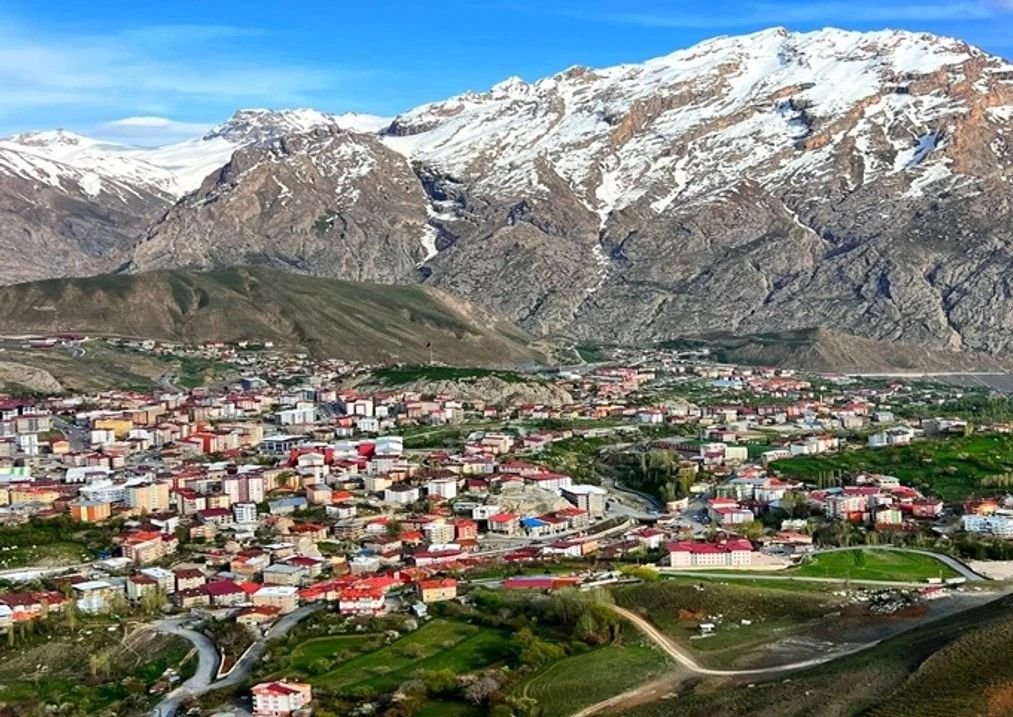
203 km southeast of Van City, is Hakkari, sits at an altitude of 1700 m, with high mountains dominating the land, and wide valleys separate the great peaks with heights exceeding 4000 m.
Mounts Cilo and Sat are two of the outstanding ones for mountaineering and winter sports. The snow accumulating on the upper parts of these mountains form beautiful glaciers. The Zap Valley, through which the road to the city passes, offers fantastic scenery.
This land has witnessed the passing of tribes since earliest times. The medieval fortress reflects the history of this small region and is worth seeing, together with the Medresse standing nearby. Formerly Colemerik, city, capital of Hakkari il (province), southeastern Turkey.
It lies at an altitude of about 1,700 m (5,500 ft) , surrounded by mountains and overlooked by a medieval fortress, the former residence of its Kurdish rulers. A market for local livestock and livestock products, Hakkari has road links to Van to the north and Siirt to the west.
Hakkari il, with an area of 3,817 sq mi (9,885 sq km), is drained by the Great Zab River (Buyukzap Suyu). Iran borders it on the east and Iraq on the south. Mostly mountainous, it is the most sparsely populated and isolated il in Turkey.
East of Hakkari city rise the high ranges of the Cilo (13,700 ft) and Sat (12,500 ft) mountains. Cropland is scarce, and the proportion of land under cultivation is among the nation’s lowest. Livestock raising is the main activity.
The largely Kurdish population is semi-nomadic, moving to higher summer pastures in season. Although the region was annexed to the Ottoman Empire in 1515-16, it was ruled largely by local Kurdish amirs under nominal Ottoman suzerainty until the mid-19th century.
A Vertical Landscape: The Turkish Alps
Hakkari is arguably the most mountainous province in Turkey, with nearly 88% of its terrain consisting of steep inclines.
Cilo-Sat Mountains National Park: This is the crown jewel of the region. It is home to Uludoruk (Resko), Turkey’s second-highest peak at 4,135 meters. Remarkably, this area hosts 20,000-year-old glaciers-the largest in the country-that survive even the heat of summer.
The Glacial Lakes: High-altitude wonders like Seyithan and Lis lakes offer surreal, crystal-blue reflections of the surrounding peaks, accessible only to those willing to trek into the wild.
Zap Valley: The Great Zab River carves a dramatic path through the province. It is one of Turkey’s fastest-flowing rivers, making it a premier (and adrenaline-pumping) destination for professional rafting.
A Crossroads of Civilizations
Hakkari’s isolation has preserved layers of history that are often overlooked.
Meydan Madrasah: Located in the city center, this 18th-century Ottoman structure is a testament to the region’s historical role as a center for Islamic education and architecture.
The Nestorian Heritage: In the village of Konak (Kocanis), you can find the ruins of the Kocanis Church, which served as the patriarchate for Assyrian Christians for centuries before they migrated a hundred years ago.
Ancient Rock Paintings: High in the Cilo Mountains, mysterious rock engravings dating back 5,000 years depict hunters and wildlife, proving that humans have braved these altitudes since the Bronze Age.
The Flavors of the High Plateau
Hakkari’s cuisine is designed for the energy demands of mountain life, relying heavily on meat, dairy, and wild mountain herbs.
Keledos: A registered “Geographical Indication” dish, this 1,800-year-old recipe features lamb, chickpeas, and a specific blend of sun-dried mountain herbs (pancar) mixed with strained yogurt.
Otlu Peynir (Herby Cheese): While Van is famous for it, Hakkari’s version uses unique local weeds like siyabo and mend, giving it a sharp, earthy flavor profile.
The Reversed Tulip (Ters Lale): Known locally as the “Crying Tulip,” this rare, endemic flower is the symbol of Hakkari. It blooms downward in the spring, painting the mountain slopes in shades of deep red and orange.
Travel in 2026: An Emerging Frontier
For a long time, Hakkari was “the shy city” of the southeast, but in 2026, it is emerging as a hub for adventure tourism.
Skiing: The Merga Butan Ski Center, just 12 km from the center, offers one of the longest skiing seasons in Turkey, often stretching from November until late April.
Mountaineering: New technical climbing routes have recently been opened on the “Cafer Tower” and other peaks, attracting elite climbers from around the globe.