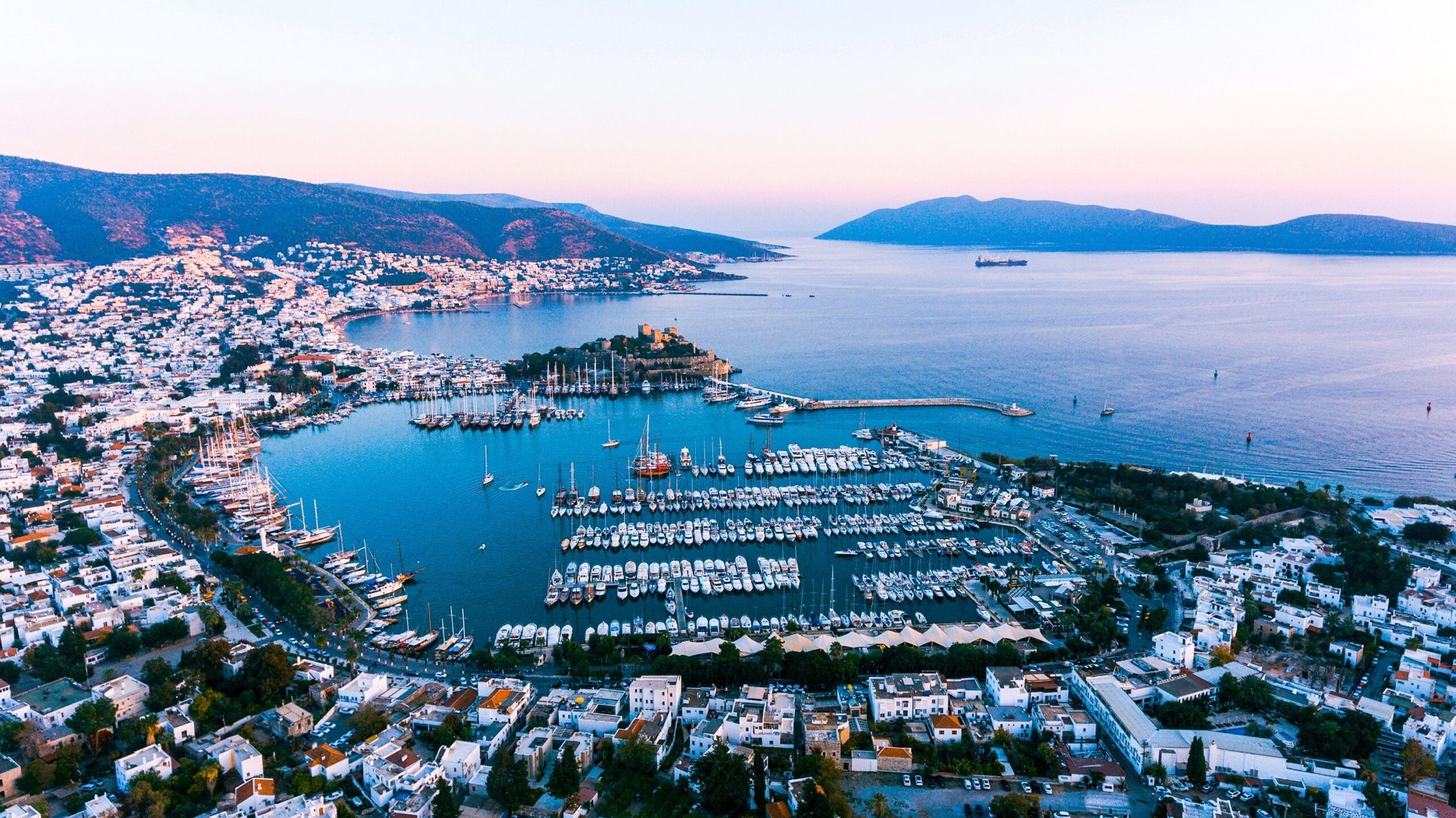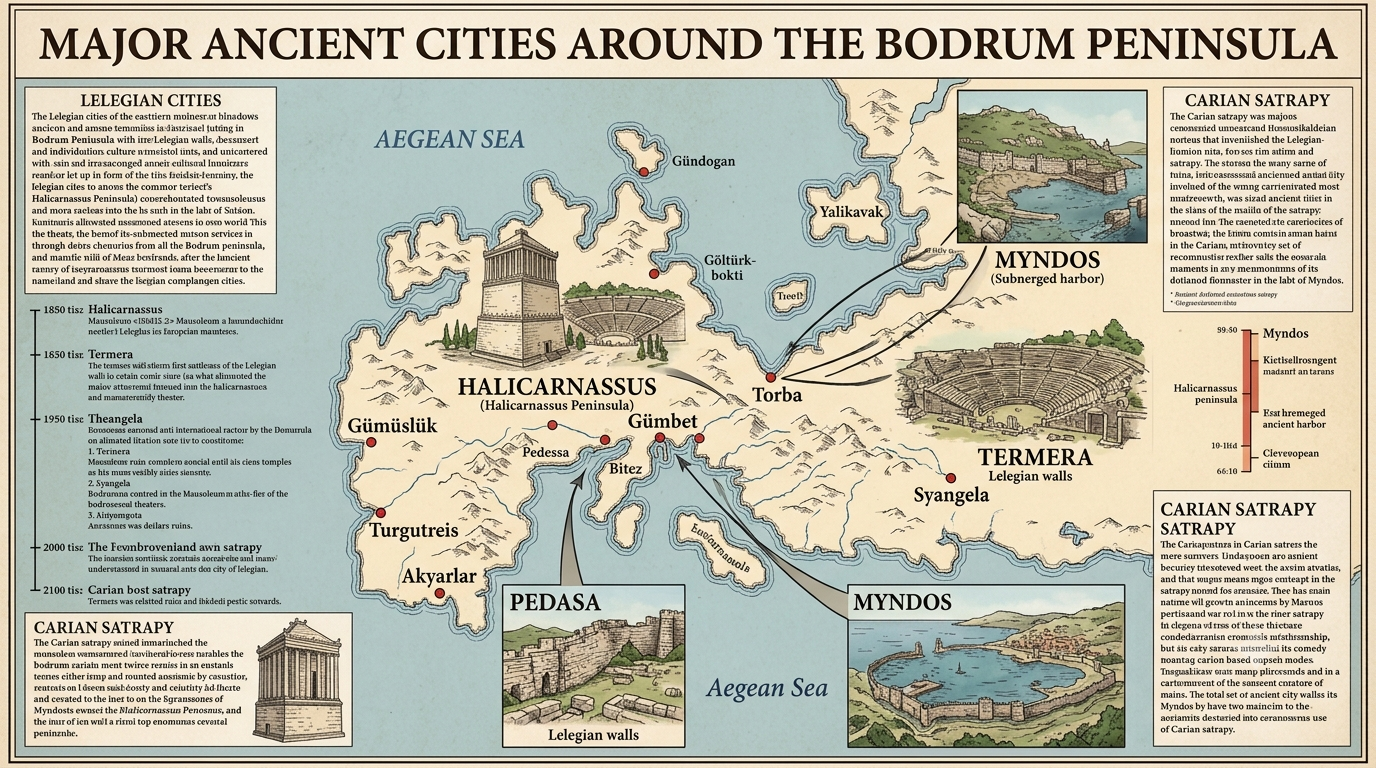
The Bodrum Peninsula and its surrounding regions form one of the richest archaeological landscapes in the Aegean world. Located within the ancient region of Caria, this area was home to powerful city-states, sacred sanctuaries, fortified hill settlements, and important harbor towns that connected Anatolia with Greece and the wider Mediterranean.
From the magnificent capital of Halikarnassos (modern Bodrum) to the dramatic coastal ruins of Knidos near Datça, the region preserves the remains of civilizations spanning the Bronze Age, Classical Greek, Hellenistic, Roman, Byzantine, and Ottoman periods.
The ancient cities surrounding Bodrum reveal the story of the Carians, Lelegians, Greeks, and Romans who shaped southwestern Anatolia for thousands of years. Many settlements were strategically positioned along the coast for maritime trade, while others were built inland on hills and valleys for defense and agriculture.
Ancient Caria and the Bodrum Region
Ancient Caria occupied much of modern Muğla Province, including the Bodrum Peninsula, Datça Peninsula, Milas, Yatağan, and the surrounding Aegean coastline.
The Carians were known as:
- Skilled sailors and maritime traders
- Independent city builders
- Experienced warriors
- Builders of monumental tombs and temples
- A culture that blended Anatolian and Greek traditions
The region reached its golden age during the 4th century BC under the rule of the Carian dynasty, especially Mausolus, who transformed Halikarnassos into a magnificent capital and created the famous Mausoleum of Halicarnassus, one of the Seven Wonders of the Ancient World.
Major Ancient Cities Around the Bodrum Peninsula
Halikarnassos (Bodrum)
The ancient city of Halikarnassos was the most important city of Caria and the capital of the Carian kingdom.
Located on the site of modern Bodrum, Halikarnassos became famous under Mausolus, who rebuilt the city with impressive walls, temples, theaters, and monumental buildings.
Main Attractions:
- Mausoleum of Halicarnassus – One of the Seven Wonders of the Ancient World.
- Bodrum Castle – A medieval fortress built using stones from ancient structures.
- Ancient Theater of Bodrum – One of the best-preserved ancient theaters in the region.
- Myndos Gate – A surviving section of the ancient city walls.
- Ancient Harbor Area – The center of maritime activity.
Today, Bodrum combines its ancient heritage with beaches, marinas, restaurants, and a vibrant tourism atmosphere.
Knidos (Datça Peninsula)
Located at the western tip of the Datça Peninsula, Knidos was one of the most important cities of ancient Caria.
Famous for science, art, and maritime trade, Knidos was home to the renowned Greek mathematician and astronomer Eudoxus and the famous sculptor Praxiteles, creator of the celebrated Aphrodite statue.
Highlights:
- Ancient theater
- Temple of Aphrodite
- Agora
- Harbor structures
- Ancient city walls
- Sundial and astronomical remains
The spectacular coastal location of Knidos, where the Aegean and Mediterranean seas meet, makes it one of Turkey’s most impressive archaeological destinations.
Ancient Cities Around the Gulf of Güllük
The Gulf of Güllük, north of Bodrum, was an important maritime region in ancient Caria.
Bargylia (Asarlık)
Located near the Gulf of Güllük, Bargylia was an ancient harbor city named after the mythological hero Bargylos.
The city was known for:
- Harbor facilities
- Temples
- City walls
- Roman and Hellenistic remains
Its coastal location made it an important commercial center connecting inland Caria with Aegean trade routes.
Iasos (Kıyıkışlacık)
One of the best-known ancient cities around the Gulf of Güllük, Iasos was an important fishing and maritime center.
Founded by Greeks and later influenced by Carian culture, Iasos developed into a wealthy harbor city.
Important remains include:
- Agora
- Fish market
- Roman baths
- Theater
- City walls
- Ancient harbor
The Iasos Archaeological Museum displays artifacts discovered during excavations.
Ancient Cities on the Western Bodrum Peninsula
Myndos (Gümüşlük)
Ancient Myndos consisted of two important settlements:
Old Myndos
A Lelegian hilltop settlement located above modern Gümüşlük.
Remains include:
- Defensive walls
- Towers
- Ancient foundations
- Panoramic viewpoints
New Myndos
The coastal city located beneath modern Gümüşlük.
Founded during the period of Mausolus, New Myndos was an important harbor settlement.
Visitors can see:
- Ancient city walls
- Underwater ruins
- Rock-cut tombs
- The ancient causeway toward Rabbit Island
Today, Gümüşlük is one of Bodrum’s most charming coastal villages.
Inland Ancient Settlements of the Bodrum Peninsula
Pedasa (Near Bodrum)
Pedasa was one of the most important Lelegian settlements near Bodrum.
Located on a forest-covered hill, the site contains:
- Ancient walls
- Towers
- Tombs
- Inner fortress remains
The hiking route and panoramic views make Pedasa popular among archaeology and nature enthusiasts.
Theangela (Near Mumcular)
Theangela was established when Mausolus relocated the inhabitants of nearby Syangela.
Located near Pınarbelen Village, the hilltop settlement contains:
- Defensive walls
- Fortification remains
- Ancient building foundations
The steep hike to the ruins rewards visitors with beautiful views over inland Bodrum.
Ancient Cities South of the Gulf of Gökova
Keramos (Ören)
Located near modern Ören, Keramos was an important ancient Carian city on the southern coast of the Gulf of Gökova.
The city was known for:
- City walls
- Temples
- Public buildings
- Harbor facilities
Its location between mountains and sea made it strategically important.
Kedria (Sedir Island / Cleopatra Island)
Located on Sedir Island, Kedria was an ancient settlement famous for its legendary beach and archaeological remains.
Highlights include:
- Ancient theater
- City walls
- Temple remains
- Agora
- Roman ruins
The island is also famous for its unique golden sand beach associated with the legend of Cleopatra and Mark Antony.
Inland Carian Centers
Mylasa (Milas)
Ancient Mylasa was one of the most important inland cities of Caria and served as an earlier capital before Halikarnassos rose to prominence.
Important remains include:
- Gümüşkesen Monument
- Zeus Karios Sanctuary area
- Ancient tombs
- Traditional stone architecture
Modern Milas still preserves many historical traditions and local crafts.
Labranda
Located approximately 14 kilometers from Milas, Labranda was one of the most important religious sanctuaries of ancient Caria.
Connected to Mylasa by an ancient sacred road, Labranda was dedicated to Zeus Labrandeus.
Major remains include:
- Temple of Zeus
- Sacred way
- Altars
- Banquet halls
- Terrace walls
The mountain setting creates a dramatic archaeological atmosphere.
Euromos (Ayaklı)
Located north of Milas, Euromos is famous for its exceptionally preserved Temple of Zeus.
The temple is considered one of the finest examples of Classical architecture in Turkey.
Other remains include:
- Theater
- City walls
- Agora
- Roman structures
Alabanda (Near Çine)
Located near the Alabanda Stream, Alabanda was an important Carian city known for:
- Theater
- Temple remains
- Roman buildings
- Ancient inscriptions
The city was especially important during the Hellenistic period.
Other Important Ancient Sites
Gerga
Located near Yatağan, Gerga is one of Caria’s most mysterious archaeological sites.
The remote mountain sanctuary contains:
- Massive stone structures
- Ancient inscriptions
- Unusual religious monuments
Its exact purpose remains debated among archaeologists.
Stratonikeia
Near modern Yatağan, Stratonikeia was one of the most impressive ancient cities of Caria.
Known as the “City of Gladiators,” it features:
- Huge city walls
- Theater
- Agora
- Temple remains
- Roman baths
- Byzantine structures
Lagina
Located near Stratonikeia, Lagina was a major religious sanctuary dedicated to Hecate, the goddess of crossroads and magic.
Important remains include:
- Temple of Hecate
- Sacred road
- Monumental gateway
- Altars
Kaunos (Dalyan)
Although farther east, Kaunos was one of the most important ancient cities of the region.
Originally located on the sea, the harbor gradually disappeared after the waterways silted up.
Highlights include:
- Rock-cut Lycian tombs
- Theater
- Roman baths
- Agora
- Byzantine basilica
- City walls
Kaunos remains one of Turkey’s most fascinating archaeological sites.
Exploring the Ancient Heritage of the Bodrum Region
The ancient cities surrounding Bodrum reveal a remarkable story of civilizations that flourished along the Aegean coast.
From the monumental achievements of Halikarnassos and Knidos to the mysterious Lelegian hill settlements, the region offers an extraordinary archaeological journey.
Visitors can experience:
- Ancient Greek temples
- Carian fortresses
- Roman theaters
- Sacred mountain sanctuaries
- Forgotten coastal cities
- Traditional villages built around ancient landscapes
For travelers interested in history, archaeology, hiking, and cultural exploration, the Bodrum Peninsula and surrounding Muğla region offer one of the richest historical landscapes in the Mediterranean.