Category: Archaeology

  • Historical Remains Near the Bodrum Peninsula, Mugla, Turkey

    Historical Remains Near the Bodrum Peninsula, Mugla, Turkey

    The Bodrum Peninsula and its surrounding regions form one of the richest archaeological landscapes in the Aegean world. Located within the ancient region of Caria, this area was home to powerful city-states, sacred sanctuaries, fortified hill settlements, and important harbor towns that connected Anatolia with Greece and the wider Mediterranean.

    From the magnificent capital of Halikarnassos (modern Bodrum) to the dramatic coastal ruins of Knidos near Datça, the region preserves the remains of civilizations spanning the Bronze Age, Classical Greek, Hellenistic, Roman, Byzantine, and Ottoman periods.

    The ancient cities surrounding Bodrum reveal the story of the Carians, Lelegians, Greeks, and Romans who shaped southwestern Anatolia for thousands of years. Many settlements were strategically positioned along the coast for maritime trade, while others were built inland on hills and valleys for defense and agriculture.

    Ancient Caria and the Bodrum Region

    Ancient Caria occupied much of modern Muğla Province, including the Bodrum Peninsula, Datça Peninsula, Milas, Yatağan, and the surrounding Aegean coastline.

    The Carians were known as:

    • Skilled sailors and maritime traders
    • Independent city builders
    • Experienced warriors
    • Builders of monumental tombs and temples
    • A culture that blended Anatolian and Greek traditions

    The region reached its golden age during the 4th century BC under the rule of the Carian dynasty, especially Mausolus, who transformed Halikarnassos into a magnificent capital and created the famous Mausoleum of Halicarnassus, one of the Seven Wonders of the Ancient World.


    Major Ancient Cities Around the Bodrum Peninsula

    Halikarnassos (Bodrum)

    The ancient city of Halikarnassos was the most important city of Caria and the capital of the Carian kingdom.

    Located on the site of modern Bodrum, Halikarnassos became famous under Mausolus, who rebuilt the city with impressive walls, temples, theaters, and monumental buildings.

    Main Attractions:

    • Mausoleum of Halicarnassus – One of the Seven Wonders of the Ancient World.
    • Bodrum Castle – A medieval fortress built using stones from ancient structures.
    • Ancient Theater of Bodrum – One of the best-preserved ancient theaters in the region.
    • Myndos Gate – A surviving section of the ancient city walls.
    • Ancient Harbor Area – The center of maritime activity.

    Today, Bodrum combines its ancient heritage with beaches, marinas, restaurants, and a vibrant tourism atmosphere.


    Knidos (Datça Peninsula)

    Located at the western tip of the Datça Peninsula, Knidos was one of the most important cities of ancient Caria.

    Famous for science, art, and maritime trade, Knidos was home to the renowned Greek mathematician and astronomer Eudoxus and the famous sculptor Praxiteles, creator of the celebrated Aphrodite statue.

    Highlights:

    • Ancient theater
    • Temple of Aphrodite
    • Agora
    • Harbor structures
    • Ancient city walls
    • Sundial and astronomical remains

    The spectacular coastal location of Knidos, where the Aegean and Mediterranean seas meet, makes it one of Turkey’s most impressive archaeological destinations.


    Ancient Cities Around the Gulf of Güllük

    The Gulf of Güllük, north of Bodrum, was an important maritime region in ancient Caria.

    Bargylia (Asarlık)

    Located near the Gulf of Güllük, Bargylia was an ancient harbor city named after the mythological hero Bargylos.

    The city was known for:

    • Harbor facilities
    • Temples
    • City walls
    • Roman and Hellenistic remains

    Its coastal location made it an important commercial center connecting inland Caria with Aegean trade routes.


    Iasos (Kıyıkışlacık)

    One of the best-known ancient cities around the Gulf of Güllük, Iasos was an important fishing and maritime center.

    Founded by Greeks and later influenced by Carian culture, Iasos developed into a wealthy harbor city.

    Important remains include:

    • Agora
    • Fish market
    • Roman baths
    • Theater
    • City walls
    • Ancient harbor

    The Iasos Archaeological Museum displays artifacts discovered during excavations.


    Ancient Cities on the Western Bodrum Peninsula

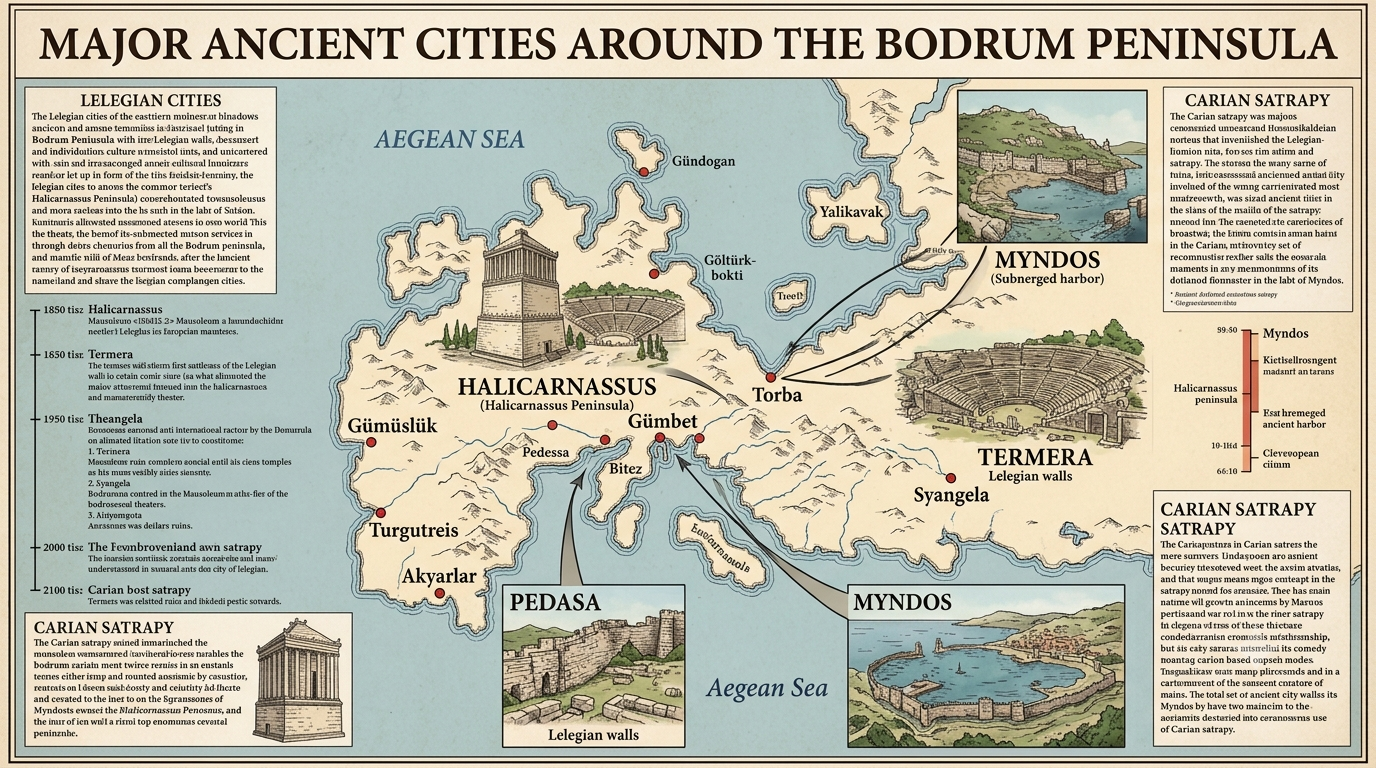
    Myndos (Gümüşlük)

    Ancient Myndos consisted of two important settlements:

    Old Myndos

    A Lelegian hilltop settlement located above modern Gümüşlük.

    Remains include:

    • Defensive walls
    • Towers
    • Ancient foundations
    • Panoramic viewpoints

    New Myndos

    The coastal city located beneath modern Gümüşlük.

    Founded during the period of Mausolus, New Myndos was an important harbor settlement.

    Visitors can see:

    • Ancient city walls
    • Underwater ruins
    • Rock-cut tombs
    • The ancient causeway toward Rabbit Island

    Today, Gümüşlük is one of Bodrum’s most charming coastal villages.


    Inland Ancient Settlements of the Bodrum Peninsula

    Pedasa (Near Bodrum)

    Pedasa was one of the most important Lelegian settlements near Bodrum.

    Located on a forest-covered hill, the site contains:

    • Ancient walls
    • Towers
    • Tombs
    • Inner fortress remains

    The hiking route and panoramic views make Pedasa popular among archaeology and nature enthusiasts.


    Theangela (Near Mumcular)

    Theangela was established when Mausolus relocated the inhabitants of nearby Syangela.

    Located near Pınarbelen Village, the hilltop settlement contains:

    • Defensive walls
    • Fortification remains
    • Ancient building foundations

    The steep hike to the ruins rewards visitors with beautiful views over inland Bodrum.


    Ancient Cities South of the Gulf of Gökova

    Keramos (Ören)

    Located near modern Ören, Keramos was an important ancient Carian city on the southern coast of the Gulf of Gökova.

    The city was known for:

    • City walls
    • Temples
    • Public buildings
    • Harbor facilities

    Its location between mountains and sea made it strategically important.


    Kedria (Sedir Island / Cleopatra Island)

    Located on Sedir Island, Kedria was an ancient settlement famous for its legendary beach and archaeological remains.

    Highlights include:

    • Ancient theater
    • City walls
    • Temple remains
    • Agora
    • Roman ruins

    The island is also famous for its unique golden sand beach associated with the legend of Cleopatra and Mark Antony.


    Inland Carian Centers

    Mylasa (Milas)

    Ancient Mylasa was one of the most important inland cities of Caria and served as an earlier capital before Halikarnassos rose to prominence.

    Important remains include:

    • Gümüşkesen Monument
    • Zeus Karios Sanctuary area
    • Ancient tombs
    • Traditional stone architecture

    Modern Milas still preserves many historical traditions and local crafts.


    Labranda

    Located approximately 14 kilometers from Milas, Labranda was one of the most important religious sanctuaries of ancient Caria.

    Connected to Mylasa by an ancient sacred road, Labranda was dedicated to Zeus Labrandeus.

    Major remains include:

    • Temple of Zeus
    • Sacred way
    • Altars
    • Banquet halls
    • Terrace walls

    The mountain setting creates a dramatic archaeological atmosphere.


    Euromos (Ayaklı)

    Located north of Milas, Euromos is famous for its exceptionally preserved Temple of Zeus.

    The temple is considered one of the finest examples of Classical architecture in Turkey.

    Other remains include:

    • Theater
    • City walls
    • Agora
    • Roman structures

    Alabanda (Near Çine)

    Located near the Alabanda Stream, Alabanda was an important Carian city known for:

    • Theater
    • Temple remains
    • Roman buildings
    • Ancient inscriptions

    The city was especially important during the Hellenistic period.


    Other Important Ancient Sites

    Gerga

    Located near Yatağan, Gerga is one of Caria’s most mysterious archaeological sites.

    The remote mountain sanctuary contains:

    • Massive stone structures
    • Ancient inscriptions
    • Unusual religious monuments

    Its exact purpose remains debated among archaeologists.


    Stratonikeia

    Near modern Yatağan, Stratonikeia was one of the most impressive ancient cities of Caria.

    Known as the “City of Gladiators,” it features:

    • Huge city walls
    • Theater
    • Agora
    • Temple remains
    • Roman baths
    • Byzantine structures

    Lagina

    Located near Stratonikeia, Lagina was a major religious sanctuary dedicated to Hecate, the goddess of crossroads and magic.

    Important remains include:

    • Temple of Hecate
    • Sacred road
    • Monumental gateway
    • Altars

    Kaunos (Dalyan)

    Although farther east, Kaunos was one of the most important ancient cities of the region.

    Originally located on the sea, the harbor gradually disappeared after the waterways silted up.

    Highlights include:

    • Rock-cut Lycian tombs
    • Theater
    • Roman baths
    • Agora
    • Byzantine basilica
    • City walls

    Kaunos remains one of Turkey’s most fascinating archaeological sites.


    Exploring the Ancient Heritage of the Bodrum Region

    The ancient cities surrounding Bodrum reveal a remarkable story of civilizations that flourished along the Aegean coast.

    From the monumental achievements of Halikarnassos and Knidos to the mysterious Lelegian hill settlements, the region offers an extraordinary archaeological journey.

    Visitors can experience:

    • Ancient Greek temples
    • Carian fortresses
    • Roman theaters
    • Sacred mountain sanctuaries
    • Forgotten coastal cities
    • Traditional villages built around ancient landscapes

    For travelers interested in history, archaeology, hiking, and cultural exploration, the Bodrum Peninsula and surrounding Muğla region offer one of the richest historical landscapes in the Mediterranean.

  • Historical Sites in Antalya: Discover the Ancient Treasures of Turkiye’s Mediterranean Coast

    Antalya is one of Türkiye’s most remarkable historical destinations, where thousands of years of civilization meet the stunning landscapes of the Mediterranean coast. Often referred to as the Turkish Riviera, the province is renowned not only for its beautiful beaches and luxury resorts but also for its extraordinary collection of ancient cities, Roman theaters, Byzantine churches, Ottoman architecture, and archaeological museums.

    The region has been home to the Lycians, Pamphylians, Pisidians, Greeks, Romans, Byzantines, Seljuks, and Ottomans, each leaving behind an impressive cultural legacy. Today, visitors can explore remarkably preserved archaeological sites, many set against breathtaking mountain and coastal scenery.


    Kaleiçi (Antalya Old Town)

    At the heart of modern Antalya lies Kaleiçi, the city’s beautifully preserved historic quarter. Enclosed by ancient Roman walls, its narrow cobbled streets are lined with restored Ottoman mansions, boutique hotels, cafés, and artisan shops.

    Highlights include:

    • Ottoman-era houses
    • Ancient city walls
    • Traditional courtyards
    • Historic mosques
    • Boutique museums
    • Small harbors
    • Local restaurants

    Kaleiçi perfectly combines history with modern Mediterranean charm.


    Hadrian’s Gate

    One of Antalya’s most iconic landmarks, Hadrian’s Gate was built in 130 AD to commemorate the visit of the Roman Emperor Hadrian.

    This magnificent triumphal gate features:

    • Three marble arches
    • Corinthian columns
    • Decorative carvings
    • Ancient towers
    • Original Roman stone pavement

    It once served as the ceremonial entrance to the ancient city of Attaleia and remains one of the finest examples of Roman architecture in Türkiye.


    Yivli Minaret (Fluted Minaret)

    The Yivli Minaret is one of Antalya’s best-known symbols. Constructed during the 13th century by the Seljuk Sultan Alaeddin Keykubad I, the distinctive brick minaret rises approximately 38 meters above the old city.

    The adjoining mosque and complex include:

    • Islamic art
    • Historic tombs
    • Religious schools
    • Beautiful courtyards

    The minaret represents one of the finest examples of early Seljuk architecture.


    Hıdırlık Tower

    Standing at the edge of Kaleiçi overlooking the Mediterranean Sea, Hıdırlık Tower dates to the 2nd century AD.

    Historians believe it served as either:

    • A Roman watchtower
    • A defensive fortification
    • A lighthouse
    • A mausoleum

    Today it offers spectacular sunset views over Antalya’s harbor.


    Antalya Archaeological Museum

    One of Türkiye’s most important museums, the Antalya Archaeological Museum houses thousands of artifacts recovered from ancient cities across the region.

    Highlights include:

    • Roman statues
    • Greek sculptures
    • Sarcophagi
    • Mosaics
    • Coins
    • Byzantine artifacts
    • Lycian inscriptions
    • Children’s museum

    The museum provides an excellent introduction to Antalya’s rich archaeological heritage.


    Ancient City of Perge

    Located approximately 18 kilometers east of Antalya, Perge was once the capital of ancient Pamphylia.

    Founded during the Hellenistic period and flourishing under Roman rule, the city features remarkably preserved ruins including:

    • Monumental Roman gates
    • Colonnaded streets
    • Roman baths
    • Agora
    • Stadium
    • Theater
    • Gymnasium
    • Fountains

    Perge is considered one of the finest archaeological sites in the Mediterranean.


    Aspendos Ancient City

    The ancient city of Aspendos is world-famous for its exceptionally preserved Roman theatre.

    Built during the reign of Emperor Marcus Aurelius in the 2nd century AD, the theatre could accommodate approximately 15,000 spectators and is still used today for concerts and international festivals thanks to its outstanding acoustics.

    Other attractions include:

    • Roman aqueducts
    • Basilica
    • Agora
    • Stadium
    • Ancient bridges

    Side Ancient City

    Located on a picturesque peninsula east of Antalya, Side combines archaeological treasures with beautiful beaches.

    Major attractions include:

    • Temple of Apollo
    • Roman Theatre
    • Ancient harbor
    • Agora
    • Roman baths
    • City walls
    • Monumental Gate
    • Nymphaeum

    The Temple of Apollo overlooking the Mediterranean is among Türkiye’s most photographed historical landmarks.


    Termessos Ancient City

    Hidden high in the Taurus Mountains within Güllük Mountain National Park, Termessos is one of Türkiye’s most spectacular archaeological sites.

    Unlike many ancient cities, Termessos was never conquered by Alexander the Great due to its naturally fortified mountain location.

    Visitors can explore:

    • Mountain theatre
    • Necropolis
    • Agora
    • Temples
    • Gymnasium
    • Ancient cisterns
    • Defensive walls

    The dramatic scenery makes Termessos a favorite among hikers and photographers.


    Phaselis Ancient City

    Situated between Kemer and Tekirova, Phaselis was an important Lycian and Roman port city.

    The site uniquely combines archaeology with nature.

    Visitors enjoy:

    • Three ancient harbors
    • Roman aqueduct
    • Theatre
    • Agora
    • Baths
    • Forest walking paths
    • Beaches

    Swimming among ancient ruins makes Phaselis one of Antalya’s most memorable destinations.


    Olympos Ancient City

    Nestled within a lush valley near Çıralı, Olympos was one of the principal cities of the Lycian League.

    Its atmospheric ruins include:

    • Roman baths
    • Necropolis
    • Theatre
    • Byzantine churches
    • Sarcophagi
    • Ancient harbor remains

    The nearby beach is also an important nesting site for endangered loggerhead sea turtles.


    Myra Ancient City

    Located near Demre, Myra was one of the greatest cities of ancient Lycia.

    Its most famous features include:

    • Rock-cut Lycian tombs
    • Roman theatre
    • Ancient acropolis
    • Agora
    • Byzantine remains

    The elaborate cliffside tombs are among the finest examples of Lycian funerary architecture.


    Church of St. Nicholas (Demre)

    Demre is home to the Church of St. Nicholas, dedicated to the 4th-century bishop who inspired the legend of Santa Claus.

    The beautifully preserved Byzantine church features:

    • Frescoes
    • Marble floors
    • Sarcophagus
    • Religious mosaics
    • Pilgrimage history

    It attracts thousands of visitors each year.


    Xanthos

    Located near the western border of Antalya Province, Xanthos was the capital of ancient Lycia and is recognized as a UNESCO World Heritage Site.

    Visitors can explore:

    • Lycian pillar tombs
    • Roman theatre
    • Agora
    • Acropolis
    • Monumental inscriptions
    • Byzantine basilicas

    Xanthos played a central role in Lycian history and culture.


    Letoon Sanctuary

    Just a few kilometers from Xanthos lies Letoon, the principal religious sanctuary of ancient Lycia.

    Dedicated to:

    • Leto
    • Apollo
    • Artemis

    The sanctuary includes:

    • Ancient temples
    • Sacred spring
    • Roman theatre
    • Inscriptions in Lycian, Greek, and Aramaic

    Together with Xanthos, Letoon forms a UNESCO World Heritage Site.


    Arykanda Ancient City

    Built dramatically on mountain terraces near Finike, Arykanda offers spectacular views and exceptionally preserved ruins.

    Highlights include:

    • Roman baths
    • Theatre
    • Stadium
    • Bouleuterion
    • Agora
    • Residential quarters

    The hillside setting makes Arykanda one of Antalya’s most scenic archaeological sites.


    Limyra Ancient City

    Once an important Lycian capital, Limyra contains:

    • Rock tombs
    • Theatre
    • Byzantine church
    • Roman bridge
    • Monumental gates

    The site is surrounded by natural springs and fertile countryside.


    Simena (Kaleköy)

    Accessible mainly by boat, Simena is a charming ancient settlement overlooking the sunken city of Kekova.

    Visitors can explore:

    • Medieval castle
    • Lycian sarcophagi
    • Ancient harbor
    • Coastal ruins
    • Panoramic sea views

    It is one of the highlights of Blue Cruise itineraries.


    Kekova Sunken City

    One of Türkiye’s most fascinating archaeological attractions, the Sunken City of Kekova preserves the submerged remains of an ancient Lycian settlement partially destroyed by earthquakes.

    Visitors explore the site by:

    • Boat tours
    • Sea kayaking
    • Private yacht excursions

    The underwater ruins are visible through the crystal-clear Mediterranean waters.


    Selge Ancient City

    Located in the Taurus Mountains near Köprülü Canyon National Park, Selge was an important Pisidian city.

    Its remains include:

    • Theatre
    • Temple ruins
    • City walls
    • Ancient streets
    • Roman bridge

    The surrounding canyon also offers excellent hiking and rafting opportunities.


    Alara Han and Alara Castle

    Located west of Alanya, these Seljuk monuments once protected important caravan routes.

    Visitors can discover:

    • Medieval caravanserai
    • Mountain fortress
    • Defensive towers
    • Panoramic viewpoints

    They provide insight into medieval trade along the Silk Road.


    Alanya Castle

    Perched on a rocky peninsula overlooking the Mediterranean, Alanya Castle is one of Türkiye’s best-preserved medieval fortresses.

    Built largely during the Seljuk period, it includes:

    • Massive defensive walls
    • Red Tower (Kızıl Kule)
    • Shipyard (Tersane)
    • Historic mosques
    • Cisterns
    • Scenic viewpoints

    The castle offers breathtaking views of Alanya’s coastline and harbor.


    UNESCO World Heritage Sites in Antalya

    Antalya Province is home to several UNESCO-recognized cultural treasures, including:

    • Xanthos-Letoon – UNESCO World Heritage Site
    • Aspendos – On UNESCO’s Tentative List
    • Perge – On UNESCO’s Tentative List
    • Termessos – Located within Güllük Mountain National Park and on UNESCO’s Tentative List

    These sites reflect the province’s outstanding archaeological significance and its role in the ancient civilizations of Lycia, Pamphylia, and Pisidia.


    Tips for Visiting Antalya’s Historical Sites

    • Visit during spring (April–May) or autumn (September–October) for pleasant weather.
    • Wear comfortable footwear, as many archaeological sites involve walking over uneven stone paths.
    • Carry water, sunscreen, and a hat, especially during the summer months.
    • Combine visits to historical sites with nearby beaches, national parks, and traditional villages.
    • Consider renting a car or joining guided tours to explore sites spread across the province.

    Antalya is far more than a beach destination—it is one of the world’s richest open-air museums. From the Roman grandeur of Aspendos and Perge to the mountain citadel of Termessos, the Lycian tombs of Myra, and the medieval fortifications of Alanya, the province offers an extraordinary journey through more than 2,500 years of history. Whether wandering the cobbled streets of Kaleiçi, discovering ancient ports along the Turquoise Coast, or exploring UNESCO-listed archaeological sites, visitors will find that Antalya’s historical treasures are among the most remarkable and rewarding cultural experiences in Türkiye.

  • Historical Sites in Izmir: Exploring the Ancient Heritage of Türkiye’s Aegean Coast

    Izmir, Türkiye’s third-largest city, is one of the country’s most historically significant destinations. Situated along the beautiful Aegean coast, the province has been continuously inhabited for more than 8,500 years, making it one of the oldest urban settlements in the Mediterranean. Throughout its long history, İzmir—known in antiquity as Smyrna—has been home to the Hittites, Aeolians, Ionians, Lydians, Persians, Greeks, Romans, Byzantines, Seljuks, and Ottomans.

    Today, İzmir offers visitors an extraordinary blend of ancient cities, Roman monuments, medieval fortresses, Ottoman landmarks, archaeological museums, and UNESCO World Heritage Sites. From the bustling streets of modern İzmir to the remarkably preserved ruins of Ephesus and Pergamon, the province is a paradise for history enthusiasts and cultural travelers.


    Ancient City of Ephesus

    The Ancient City of Ephesus is Türkiye’s most famous archaeological site and one of the best-preserved classical cities in the world. Designated as a UNESCO World Heritage Site, Ephesus was once one of the largest cities of the Roman Empire and an important center of commerce, religion, and culture.

    Highlights include:

    • Library of Celsus
    • Great Theatre
    • Marble Street
    • Temple of Hadrian
    • Terrace Houses
    • Agora
    • Roman Baths
    • Curetes Street
    • Harbor Avenue

    Walking through Ephesus offers an unforgettable glimpse into daily life during the Roman period.


    House of the Virgin Mary

    Located on Mount Koressos near Ephesus, the House of the Virgin Mary is believed by many Christians to be the final residence of Mary, the mother of Jesus.

    The peaceful sanctuary attracts pilgrims and visitors from around the world and includes:

    • Chapel
    • Holy spring
    • Prayer wall
    • Walking trails
    • Beautiful forest surroundings

    It has been visited by several Popes and remains one of Türkiye’s most important religious sites.


    Temple of Artemis

    Once considered one of the Seven Wonders of the Ancient World, the Temple of Artemis stood near Ephesus and was one of the largest temples ever constructed in antiquity.

    Although only a few columns remain today, the site represents one of the most significant religious centers of the ancient world and offers insight into the grandeur of Ionian architecture.


    Ancient City of Pergamon (Bergama)

    The ancient city of Pergamon, located in modern-day Bergama, is another UNESCO World Heritage Site renowned for its impressive hilltop acropolis.

    Major attractions include:

    • Acropolis
    • Steep ancient theatre
    • Temple of Trajan
    • Altar of Zeus (site)
    • Sanctuary of Athena
    • Library of Pergamon
    • Royal palaces
    • Gymnasium
    • City walls

    Pergamon was one of the leading cultural and scientific centers of the Hellenistic world.


    Asklepion of Pergamon

    The Asklepion was one of antiquity’s most celebrated medical centers and healing sanctuaries.

    Dedicated to Asclepius, the Greek god of medicine, the complex features:

    • Sacred healing tunnels
    • Ancient hospital
    • Theatre
    • Temple
    • Treatment rooms
    • Sacred spring
    • Colonnaded streets

    Patients from across the Roman Empire traveled here seeking medical treatment.


    Smyrna Agora

    Located in the heart of modern İzmir, the Agora of Smyrna is one of the finest Roman agoras preserved in Türkiye.

    Originally built during the Hellenistic period and rebuilt after an earthquake under Emperor Marcus Aurelius, visitors can explore:

    • Roman arches
    • Colonnades
    • Ancient marketplace
    • Water channels
    • Graffiti inscriptions
    • Courtyards

    The site provides a fascinating contrast between ancient ruins and the modern city.


    Kadifekale (Velvet Castle)

    Perched on Mount Pagos overlooking İzmir, Kadifekale was originally constructed during the reign of Alexander the Great’s successors.

    Visitors enjoy:

    • Byzantine and Ottoman fortifications
    • Ancient walls
    • Observation towers
    • Panoramic views over İzmir Bay
    • Archaeological remains

    The castle remains one of the city’s best viewpoints.


    Ancient City of Teos

    Located near Sığacık in Seferihisar, Teos was an important Ionian city famous for its artistic and cultural traditions.

    Highlights include:

    • Temple of Dionysus
    • Ancient theatre
    • Bouleuterion
    • Harbor remains
    • Agora
    • City walls

    The Temple of Dionysus was designed by the renowned architect Hermogenes.


    Ancient City of Klazomenai

    Situated near Urla, Klazomenai was one of the twelve Ionian cities and became famous for producing high-quality olive oil.

    Visitors can explore:

    • Ancient olive oil workshop
    • City walls
    • Harbor remains
    • Necropolis
    • Residential quarters

    The reconstructed olive oil press is one of the oldest known production facilities in the world.


    Ancient City of Metropolis

    Located near Torbalı, Metropolis flourished during the Hellenistic and Roman periods.

    Major attractions include:

    • Theatre
    • Bouleuterion
    • Roman baths
    • Agora
    • Mosaic floors
    • Gymnasium

    Ongoing excavations continue to reveal new discoveries.


    Ancient City of Lebedos

    Lebedos was one of the smallest Ionian cities and is located near Ürkmez.

    Although much of the ancient city remains unexcavated, visitors can still see:

    • Harbor remains
    • Ancient walls
    • Foundations
    • Coastal archaeological landscape

    Ancient City of Colophon

    Once one of the wealthiest Ionian cities, Colophon became renowned for its cavalry and cultural achievements.

    Visible remains include:

    • Temple ruins
    • Acropolis
    • Ancient streets
    • Defensive walls

    The nearby Sanctuary of Apollo at Claros formed an important religious center.


    Claros Sanctuary

    Located near Ahmetbeyli, Claros was one of the ancient world’s most important oracle centers.

    Visitors can admire:

    • Temple of Apollo
    • Sacred spring
    • Monumental columns
    • Ancient inscriptions
    • Ceremonial areas

    Pilgrims traveled here from across the Mediterranean seeking divine guidance.


    Ancient City of Notion

    Situated close to Claros, Notion occupies a scenic hill overlooking the Aegean Sea.

    Highlights include:

    • Theatre
    • Temple remains
    • City walls
    • Harbor views
    • Acropolis

    Its peaceful setting makes it an excellent destination for archaeology enthusiasts.


    Ancient City of Phocaea (Foça)

    Modern Foça preserves the heritage of ancient Phocaea, one of the great Ionian maritime cities.

    Historical attractions include:

    • Ancient city walls
    • Rock-cut tombs
    • Medieval castle
    • Ottoman houses
    • Harbor fortifications

    Phocaean sailors established colonies throughout the western Mediterranean, including Marseille in France.


    Çeşme Castle

    Built in 1508 during the reign of Sultan Bayezid II, Çeşme Castle overlooks the town’s picturesque harbor.

    Inside the castle visitors can explore:

    • Archaeological Museum
    • Ottoman military exhibits
    • Ancient artifacts
    • Defensive towers
    • Sea views

    The castle played an important role in protecting the Aegean coastline.


    Birgi Historic Village

    Located near Ödemiş, Birgi is one of Türkiye’s finest preserved Ottoman settlements.

    Its historical attractions include:

    • Ottoman mansions
    • Stone streets
    • Aydınoğlu Mehmet Bey Mosque
    • Historic fountains
    • Traditional markets
    • Tombs

    Birgi is included on UNESCO’s Tentative List.


    St. John’s Basilica

    Situated near Selçuk, the Basilica of St. John was built during the reign of Emperor Justinian in the 6th century over what is traditionally believed to be the burial place of St. John the Apostle.

    Visitors can explore:

    • Basilica ruins
    • Baptistery
    • Marble columns
    • Fortress walls
    • Scenic viewpoints

    Ayasuluk Castle

    Overlooking Selçuk, Ayasuluk Castle has Byzantine, Seljuk, and Ottoman origins.

    The fortress includes:

    • Defensive walls
    • Towers
    • Cisterns
    • Ancient churches
    • Panoramic views

    Together with Ephesus and St. John’s Basilica, it forms part of the UNESCO World Heritage Site.


    İzmir Clock Tower

    Built in 1901 to commemorate the 25th anniversary of Sultan Abdulhamid II’s reign, the elegant İzmir Clock Tower stands in Konak Square and has become the city’s most recognizable landmark.

    The beautifully decorated structure reflects a blend of Ottoman and European architectural influences.


    Kemeraltı Bazaar

    Dating back to the 17th century, Kemeraltı Bazaar is one of Türkiye’s oldest shopping districts.

    Visitors can discover:

    • Historic hans (caravanserais)
    • Ottoman mosques
    • Synagogues
    • Traditional workshops
    • Spice shops
    • Artisan boutiques
    • Local cafés

    It remains one of İzmir’s liveliest cultural and commercial centers.


    İzmir Archaeological Museum

    The museum houses an outstanding collection of artifacts recovered from ancient cities throughout the province.

    Exhibits include:

    • Greek sculptures
    • Roman statues
    • Coins
    • Ceramics
    • Sarcophagi
    • Bronze artifacts
    • Jewelry
    • Inscriptions

    It is an ideal starting point for understanding the region’s archaeological heritage.


    UNESCO World Heritage Sites in İzmir

    İzmir Province is home to several internationally recognized heritage sites:

    • Ephesus – UNESCO World Heritage Site
    • Pergamon and its Multi-Layered Cultural Landscape – UNESCO World Heritage Site

    UNESCO Tentative List sites include:

    • Birgi Historic Village
    • Foça (Phocaea)
    • Çandarlı Castle
    • Genoese Trade Route structures in the eastern Mediterranean

    These sites highlight İzmir’s exceptional role in the history of ancient Anatolia and the Mediterranean.


    Tips for Visiting İzmir’s Historical Sites

    • Plan at least four to six days to explore the province’s major archaeological attractions.
    • Wear comfortable shoes, as many ancient cities feature extensive marble streets and uneven terrain.
    • Visit early in the morning during summer to avoid high temperatures.
    • Combine historical sightseeing with visits to nearby beaches, vineyards, and traditional villages.
    • Consider renting a car to easily access sites spread across the province.

    Izmir offers one of the richest historical experiences in Türkiye, where the legacy of the ancient Greeks, Romans, Byzantines, Seljuks, and Ottomans comes to life. From the awe-inspiring ruins of Ephesus and the hilltop acropolis of Pergamon to the Roman Agora of Smyrna and the charming Ottoman streets of Birgi, the province presents an extraordinary journey through more than eight millennia of civilization. Whether you are fascinated by archaeology, architecture, religion, or cultural heritage, İzmir’s historical sites promise an unforgettable exploration of the Aegean’s remarkable past.

  • The Aspendos Ancient Theatre one of the best-preserved Roman-era theatres in the world

    The Aspendos Ancient Theatre one of the best-preserved Roman-era theatres in the world

    Turning off the AntalyaAlanya road at kilometer 30 in the direction of the village of Belkis we come to the best-preserved ancient theater in Turkey. According to Strabo, the city of Aspendos was founded by colonists who came from Argos under the leadership of Mopsos. Coins minted in the 4th and 5th centuries B.C. give the city’s name as Estwediya. (Aspendos had the distinction of being the only city besides Side that coined money in its own name at that early period.)

    For a while, the city was a member of the Athenian maritime alliance (the Delian League). A naval battle was fought off Aspendos in 469 B.C. during which the Persian fleet was defeated by the forces of the Athenian general Cimon. Despite this however we see Aspendos being used as a Persian base in 411 B.C. With Alexander’s defeat of the Persians in 334 B.C., Aspendos was freed of Persian rule. It was ruled by various Hellenistic period kings following the death of Alexander and like most other cities in Asia Minor it came under Roman rule in 133 B.C.

    The city particularly flourished in the 2nd and 3rd centuries A.D. In the 5th century the city’s name was changed to Primupolis. Aspendos was badly affected by the Arab incursions in the 8th century. The Seljuks, who arrived in the area in the 12th century, appear to have made use of some of the ancient structures, the theater being among them. One may approach the ruins by car as far as the theater and we shall begin our tour there.

    The Aspendos theater is built of regularly dressed blocks of conglomerate while the door and window frames are of a cream-coloured limestone. One enters the skene through five doors, the one in the middle on the east being larger than the other four on located two on either side. The stage building is a two-tiered facade with four rows of windows, each row of which is of a different form and size. The niches contained decorative statuary. Even today the facade has an attractive appeal.

    From inscriptions at the theater we know that the structure was built during the reign of Marcus Aurelius (161-180) by two brothers, Curtius Crispinus and Curtius Auspicatus, to be dedicated to the gods and the emperors. The architect’s name was Zeno. The auditorium is divided in two by a diazoma and there is a gallery of columns surmounting the top row of seats. While the theater appears to be built on barrel vaulted substructures, parts of it do rest against the hillside. With a seating capacity of 20,000 the Aspendos theater is still useable today.

    North of the theater at the same level is the stadium. The Aspendos stadium resembles the one at Perge: the spectator’s seats are also set on vaults. To the south of the theater are the remains of a gymnasium and baths now in ruins.If we ascend to the acropolis on the hill above the theater from the path connecting the theater and stadium we pass through the eastern of the city’s three gates into the ruins of the city proper.

    Proceeding west from this gate, we come upon a basilica, part of which was used for government and civic affairs and as a courthouse. Much of this section is still standing. The triple-nave basilica extending 105 meters to the west was a commercial building while the agora lay to its west. The agora was surrounded by public buildings. West of the agora is a covered marketplace measuring 70 meters in length.

    The front was open consisting of a row of shops with a stoa in front. North of the agora are the remains of a nymphaion (fountain) of which only the facade measuring 32.50 meters in length and 15 meters in height remains. This elaborately decorated facade has two rows of niches. Northwest of the fountain are the remains of the bouleuterion, which was used as the city state’s parliament hall.

    In the center of the ruin are the traces of the foundations of a monumental arch. At the southern end of the basilica are the remains of exedrae, which served both as pedestals for statues and stone benches for the public. Another of the remains worth mentioning at Aspendos are the city’s magnificent aqueducts, parts of which are in the nearby village and on the site of the ruins.

  • Noah’s Ark in Türkiye: Exploring the Legend, History, and Archaeological Debate

    The story of Noah’s Ark has fascinated people for thousands of years and remains one of the most famous biblical traditions connected with the lands of the Near East. According to the Book of Genesis, after the great flood, the Ark came to rest “upon the mountains of Ararat” (Genesis 8:4). For centuries, explorers, historians, religious scholars, and archaeologists have searched the region of eastern Türkiye for possible evidence connected with this ancient story.

    Today, the area around Mount Ararat (Ağrı Dağı) and eastern Anatolia continues to attract visitors interested in biblical history, archaeology, geology, and religious heritage.

    The Biblical Reference to the Mountains of Ararat

    The Bible states:

    “And the ark rested upon the mountains of Ararat.” — Genesis 8:4

    The ancient name Ararat is generally associated with the Kingdom of Urartu, an Iron Age civilization that existed around parts of modern eastern Türkiye, Armenia, and neighboring regions.

    While many people associate the biblical reference directly with modern Mount Ararat, scholars have debated the exact geographical meaning of the term. The biblical wording refers to a broader mountainous region rather than providing a precise location.

    Mount Ararat itself, located in eastern Türkiye near the borders of Armenia and Iran, has become the most famous candidate because of its historical association with the Ark tradition and its dramatic appearance as the highest peak in Türkiye.

    Ancient Historical References

    References to the Ark have appeared in several historical and religious writings.

    The Jewish historian Flavius Josephus (1st century CE) mentioned traditions that remains of the Ark were still known in the region of Armenia during his time. Earlier writers, including the Babylonian historian Berosus, also recorded traditions about the Ark and people collecting pieces of the vessel as religious objects.

    These accounts demonstrate that the Ark tradition was well known throughout the ancient Near East, although they do not provide archaeological proof of the Ark’s exact location.

    The Durupınar Formation Discovery

    One of the most famous modern claims related to Noah’s Ark is the Durupınar Formation, located near the village of Üzengili in Ağrı Province, eastern Türkiye.

    The formation gained international attention after it was identified in aerial photographs taken during a 1959 NATO mapping survey by Turkish Army Captain İlhan Durupınar. The unusual boat-like shape of the geological formation led some researchers and explorers to suggest that it could represent the remains of Noah’s Ark.

    In 1960, a team of researchers visited the site and photographs of the formation were published internationally, including in Life Magazine. The discovery generated worldwide interest.

    Research and Exploration

    Several explorers and researchers have investigated the Durupınar site over the decades. Among them was Ron Wyatt, who believed the formation represented the remains of the Ark.

    Supporters of the Ark identification have pointed to:

    • The boat-like shape of the formation
    • Its approximate dimensions compared with biblical descriptions
    • Internal formations interpreted by some as possible structural features
    • Ground surveys and scanning studies

    However, many mainstream geologists and archaeologists consider the formation to be a natural geological structure created by sedimentary and volcanic processes.

    Scientific studies have not confirmed that the site contains the remains of a wooden vessel or a man-made structure.

    The Turkish Government and Visitor Site

    The Durupınar Formation has become an important cultural and tourism attraction in eastern Türkiye. The area has received official protection status, and facilities have been developed to allow visitors to observe the formation.

    Visitors can explore:

    • The viewpoint overlooking the formation
    • Information areas explaining the Ark tradition
    • The surrounding landscapes of Ağrı Province
    • Nearby cultural and natural attractions

    The site attracts both religious pilgrims and travelers interested in archaeology, history, and unusual geological formations.

    Visiting the Noah’s Ark Region

    The eastern Anatolian region offers many attractions beyond the Ark tradition, including:

    Mount Ararat (Ağrı Dağı)

    Türkiye’s highest mountain and an important destination for mountaineering and nature tourism.

    Doğubayazıt

    A historic town near Mount Ararat, famous for:

    • Ishak Pasha Palace
    • Traditional markets
    • Mountain views

    Eastern Anatolian Landscapes

    Visitors can experience:

    • High mountain scenery
    • Kurdish and Turkish cultural traditions
    • Local cuisine
    • Ancient historical sites

    Faith, History, and Exploration

    The search for Noah’s Ark represents the intersection of faith, history, archaeology, and exploration. For many believers, possible discoveries connected with biblical events provide spiritual inspiration. For scientists and historians, the region remains an important area for studying ancient civilizations, geology, and cultural traditions.

    Although the exact location and physical evidence of Noah’s Ark remain a subject of debate, the legend continues to make eastern Türkiye one of the world’s most fascinating destinations for those interested in ancient stories, religious heritage, and exploration.

    A Journey Through One of Türkiye’s Most Mysterious Landscapes

    Whether approached from a religious, historical, or scientific perspective, the Noah’s Ark tradition adds another layer of mystery to the remarkable landscapes of eastern Türkiye. The mountains, ancient cultures, and dramatic scenery of the region offer visitors a memorable journey into one of humanity’s oldest and most enduring stories.