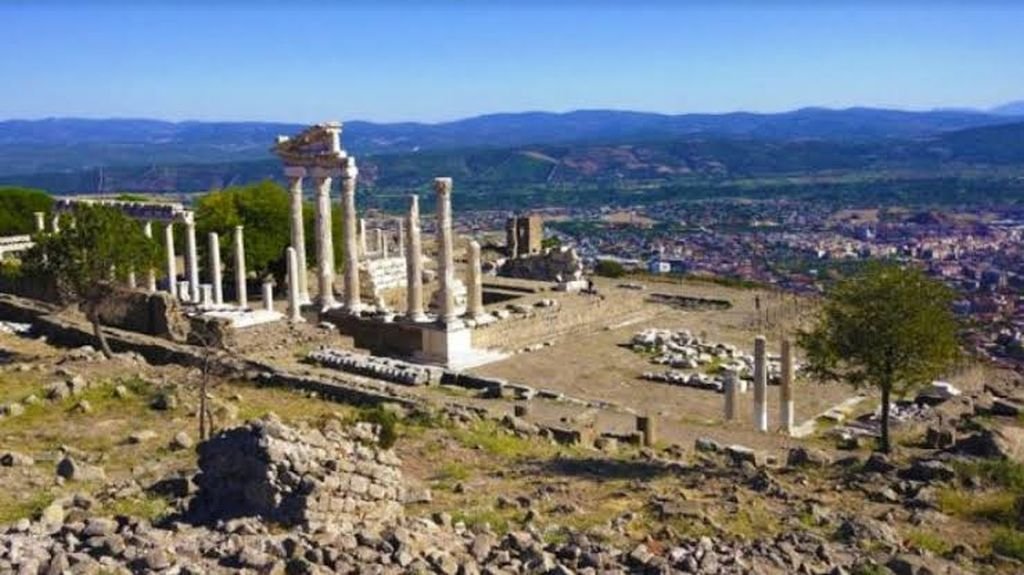
The Bergama Museum is one of Türkiye’s most important regional museums, preserving the rich archaeological and cultural heritage of the ancient city of Pergamon and its surrounding settlements. Its extensive collections span thousands of years of history, from the Early Bronze Age through the Roman and Byzantine periods, while also showcasing the traditional culture of western Anatolia.
History of the Museum
Modern archaeological research in Bergama began in 1878 under the direction of German archaeologists Carl Humann and Alexander Conze. As excavations on the Acropolis progressed, a storage museum (depot) was constructed near what is now known as the German Excavation House between 1900 and 1913. At the time, this was one of only two archaeological storage facilities of its kind in Türkiye.
Excavations were suspended during the First World War but resumed afterward under the leadership of Theodor Wiegand. As archaeological work expanded to include the famous Asklepieion, the number of discoveries increased dramatically, making a larger museum essential.
A turning point came in 1932, when Marshal Fevzi Çakmak visited Bergama and strongly supported the establishment of a permanent museum. A site that had previously served as an old cemetery was selected for the new building, and the project was designed jointly by architects Bruno Meyer and Harold Hanson as an example of Turkish-German cooperation.
Construction began in 1933 under the supervision of İzmir Governor Kazım Dirik. During his visit to Bergama on 13 April 1934, Mustafa Kemal Atatürk toured the ancient Asklepieion and observed the museum building while it was still under construction.
The museum was officially opened to the public on 30 October 1936 by İzmir Governor Fazlı Güleç, becoming one of the country’s leading archaeological museums.
Architecture
The original museum was designed around a spacious rectangular courtyard surrounded by covered galleries, with a large exhibition hall located behind it.
The courtyard functioned as an open-air museum, providing an ideal setting for displaying large stone sculptures, inscriptions, architectural fragments, and sarcophagi recovered during archaeological excavations.
As the collections continued to grow, additional exhibition space was added. In 1979, the museum’s ethnographic collections, previously displayed in the Bergama People’s House (Halkevi), were transferred to the present museum following the construction of an extension.
Further expansions introduced modern museum facilities, including:
- Collection storage areas
- Conservation and restoration laboratories
- Photography studios
- Archives
- Research and administrative offices
These additions have enabled the museum to preserve and study its growing collections according to modern museum standards.
Archaeological Collections
The archaeological section presents an outstanding collection of artifacts discovered during excavations in Bergama, Pergamon, and nearby ancient settlements.
Among the highlights are:
- Sculptures from the renowned Pergamon School of Sculpture
- Architectural elements from the Hellenistic and Roman periods
- Marble statues and reliefs
- Sarcophagi
- Ancient inscriptions
- Pottery, ceramics, and everyday household objects
- Jewelry, coins, and glassware
- Bronze tools and weapons
- Artifacts dating from the Early Bronze Age through the Byzantine Period
Particularly noteworthy are the Archaic-period finds from the ancient cities of Pitane and Gryneion, as well as the beautifully crafted terracotta figurines from Myrina, which are celebrated for their artistic quality and exceptional preservation.
Ethnography Collection
The museum’s ethnographic section offers fascinating insights into the traditional lifestyle and craftsmanship of western Anatolia.
Visitors can admire:
- Handwoven Bergama carpets
- Yuntdağ and Kozak kilims
- Traditional textile and cloth weaving
- Embroidered garments
- Household utensils
- Copperware
- Wooden handicrafts
- Traditional agricultural tools
- Regional folk costumes
- Everyday objects reflecting Anatolian village life
These collections beautifully illustrate the rich cultural traditions that have continued in the region for centuries.
A Must-Visit Museum
A visit to the Bergama Museum provides the perfect introduction to the remarkable archaeological sites of Pergamon, the Asklepieion, and the surrounding ancient settlements. Its carefully curated collections allow visitors to trace the evolution of one of the ancient world’s greatest cities while also discovering the traditional culture of the Bergama region.
Whether you are passionate about archaeology, history, art, or ethnography, the Bergama Museum offers an enriching experience that complements any visit to this UNESCO World Heritage city.