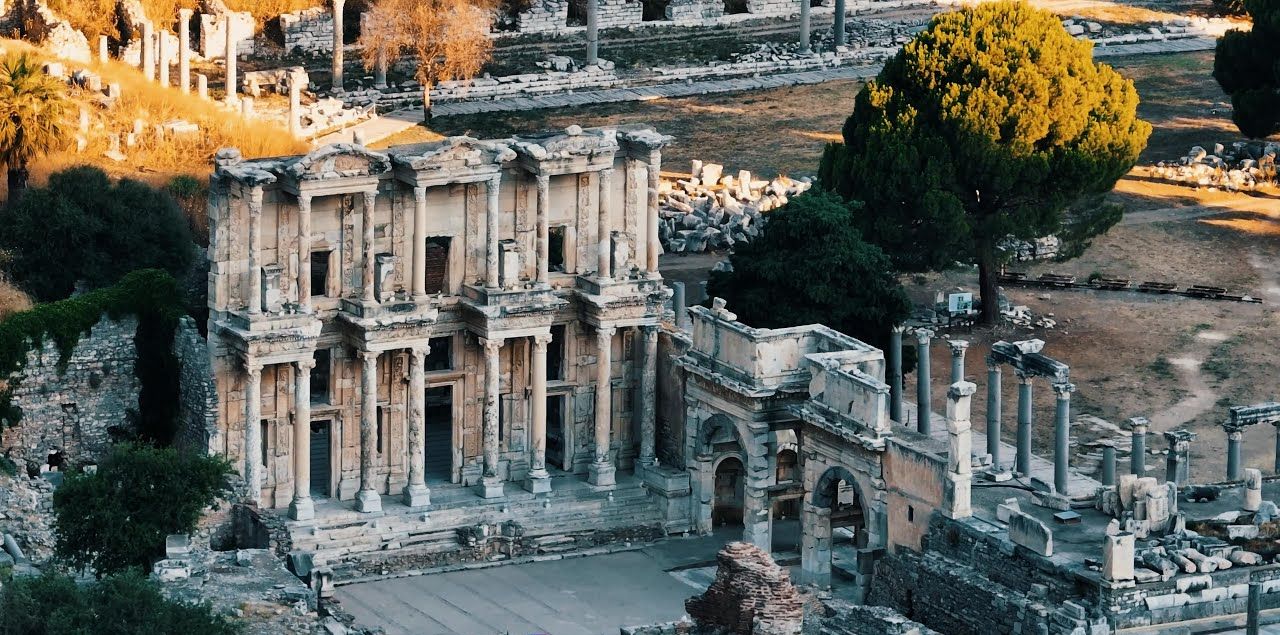
The ancient city of Ephesus, located near Selçuk in İzmir Province, is one of the most remarkable archaeological sites in the Mediterranean world. Spread across a vast landscape, the ruins reflect centuries of Greek, Roman, and Byzantine civilization. A full visit can easily take an entire day, as the site contains numerous monuments, streets, temples, and public buildings.
Ephesus Ruins
The Ephesus archaeological site is among the best-preserved ancient cities in the world. Visitors can explore an extensive urban landscape featuring temples, theatres, streets, baths, and residential areas.
Ephesus is easily accessible from Selçuk by road or public transport, and also from Kuşadası, making it one of Türkiye’s most visited historical attractions.
Byzantine Public Baths
Near the ancient stadium area, visitors can find the remains of the Byzantine Public Baths, which reflect the continued use of Ephesus during the Byzantine period. These structures demonstrate how Roman urban facilities were adapted and reused in later centuries.
Port Public Baths
Originally constructed in the 2nd century AD, the Port Public Baths were later restored and modified during the reign of Emperor Constantine (4th century AD). These baths highlight the importance of hygiene, social life, and public gathering spaces in ancient urban culture.
Arkadiane (Port Street)
The Arkadiane (Arcadian Way) is a monumental avenue stretching approximately 500 meters in length and 11 meters in width. It was renovated in the 5th century and named after Emperor Arcadius.
This grand street once led directly to the ancient harbor and was used for official processions, ceremonies, and royal receptions. It connected key parts of the city and served as a symbolic entrance to Ephesus.
Marble Street
The Marble Street runs roughly 400 meters through the city, connecting the Magnesia Gate in the southeast to the Koressos Gate in the northwest. Reconstructed in the 5th century AD, this elegant stone-paved road formed one of the main transportation routes within the city.
Scholastica Baths
The Scholastica Baths were originally built in the Roman period and later restored in the 5th century by a wealthy Ephesian woman named Scholastica.
Key features include:
- Advanced heating systems (hypocaust)
- Marble-lined interiors
- Large bathing halls and social spaces
- A statue of Scholastica at the entrance
These baths illustrate the luxury and engineering skill of Roman public facilities.
Temple of Hadrian
Located along Curetes Street, the Temple of Hadrian is one of the most elegant surviving structures in Ephesus. Although only its façade remains, it is richly decorated with mythological reliefs, including scenes associated with the founding legend of the city.
Trajan Fountain
Near the Temple of Hadrian and the Gate of Hercules, the Trajan Fountain once featured a monumental statue of Emperor Trajan. Today, parts of this statue are displayed in the Ephesus Museum. The fountain reflects the importance of imperial imagery in Roman urban design.
Terrace Houses (Slope Houses)
Located near the Library of Celsus, the Terrace Houses belonged to wealthy citizens of Ephesus. These luxurious residences provide a rare glimpse into private life in the ancient city.
Features include:
- Mosaics and frescoed walls
- Marble decorations
- Multi-level architecture
- Private courtyards and advanced plumbing systems
Temple of Domitian
The Temple of Domitian was the first temple in Ephesus dedicated to a Roman emperor. Located near the central administrative area, it played an important role in imperial worship and political authority.
Only fragments remain today, including parts of a large imperial statue, now displayed in museums in İzmir and Selçuk.
Prytaneion (City Hall)
The Prytaneion served as the administrative and ceremonial heart of Ephesus. It housed the sacred eternal flame of Hestia, symbolizing the city’s unity and continuity.
It was used for:
- Official ceremonies
- Diplomatic receptions
- Religious rituals
- Civic administration
Odeon (Bouleuterion)
The Odeon, built in the 2nd century AD by Publius Vedius Antonius, functioned as a small theatre and council chamber. It was used for political meetings, musical performances, and public discussions. The structure originally had a wooden roof.
Basilica of St. John
Located on Ayasuluk Hill, the Basilica of St. John was constructed in the 6th century AD by Emperor Justinian.
Key features:
- Cross-shaped plan
- 40 × 110 meter structure
- Central dome design
- Western entrance
- Built over the believed tomb of St. John
This basilica is one of the most important Byzantine religious structures in the region.
A City of Layers of History
Ephesus is unique for its extraordinary layering of civilizations—from Hellenistic foundations to Roman grandeur and Byzantine transformation. Each monument reflects a different stage of this long and influential history.
Why Visit Ephesus?
Ephesus is essential for travelers interested in:
- Ancient Roman and Greek cities
- Early Christian heritage
- Monumental architecture and engineering
- Archaeological exploration
- Cultural and historical tourism
A Journey Through Time
Walking through Ephesus is like traveling through thousands of years of history in a single day. From grand temples and marble streets to private homes and civic buildings, the city offers one of the most complete visions of the ancient world anywhere on Earth.