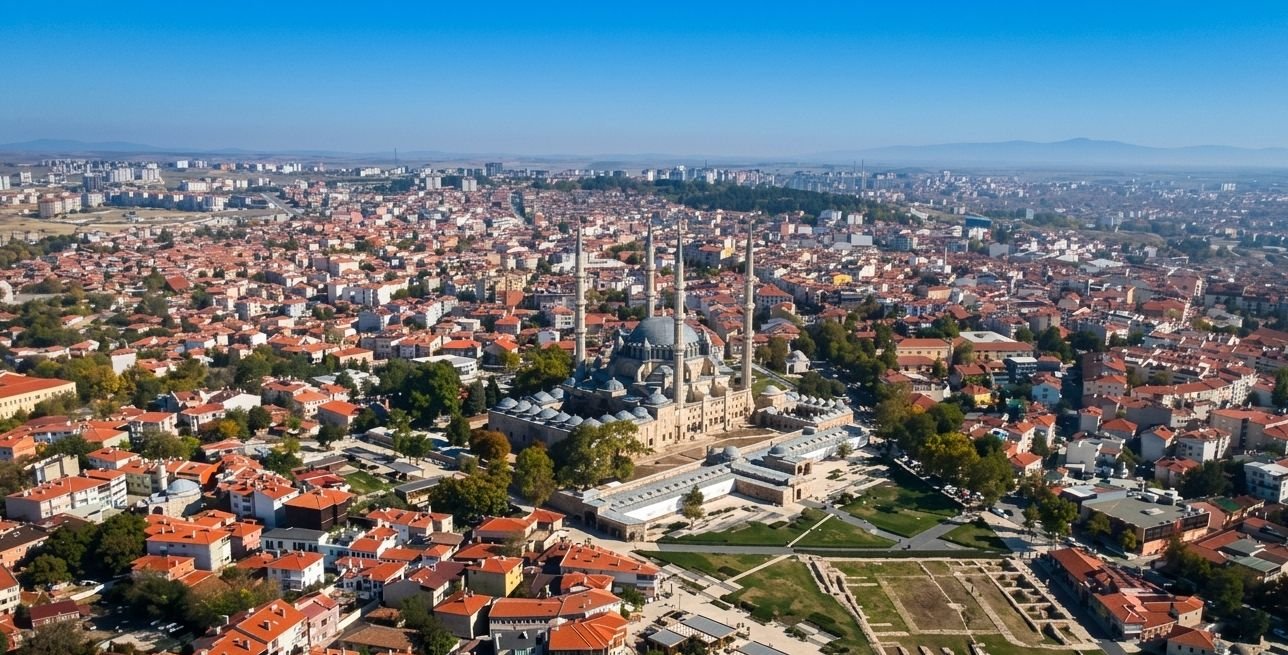
Located in the northwestern corner of Türkiye near the borders of Greece and Bulgaria, Edirne is one of the country’s most historically significant cities. Standing at the meeting point of Europe and Asia, it has served for centuries as a gateway between the Balkans and Anatolia. Rich in imperial architecture, cultural traditions, and Ottoman heritage, Edirne offers visitors an unforgettable journey through one of the greatest chapters of Turkish history.
Situated on the fertile plains where the Meriç (Maritsa), Tunca, and Arda rivers converge, Edirne is surrounded by lush agricultural landscapes, sunflower fields, vineyards, and peaceful countryside. Although often visited as a stopover between Istanbul and Europe, the city deserves several days of exploration thanks to its magnificent mosques, elegant bridges, museums, lively bazaars, and unique culinary traditions.
As the second capital of the Ottoman Empire from 1369 until the conquest of Constantinople in 1453, Edirne became one of the empire’s most important political, cultural, and military centers. During the 16th century it ranked among the largest and wealthiest cities in Europe, attracting merchants, scholars, architects, diplomats, and travelers from across the world.
Today, beautifully preserved Ottoman monuments, vibrant local festivals, and authentic neighborhoods make Edirne one of Türkiye’s most rewarding cultural destinations.
A City with More Than Two Thousand Years of History
The history of Edirne stretches back to ancient Thracian settlements. During the Roman period, Emperor Hadrian rebuilt and expanded the city in the 2nd century AD, giving it the name Hadrianopolis (Adrianople).
Following the division of the Roman Empire, the city became an important Byzantine stronghold before being conquered by Sultan Murad I in 1361. Shortly afterward, it became the Ottoman capital, a role it held for nearly a century before the imperial court moved to Constantinople (Istanbul).
The city’s strategic location made it a crossroads of civilizations where Roman, Byzantine, Balkan, and Ottoman cultures blended together, leaving behind a remarkable architectural and cultural legacy.
Selimiye Mosque – Sinan’s Greatest Masterpiece
The undisputed symbol of Edirne is the magnificent Selimiye Mosque, considered the greatest achievement of the legendary Ottoman architect Mimar Sinan.
Completed between 1569 and 1575 during the reign of Sultan Selim II, the mosque dominates the city’s skyline from a hilltop visible from nearly every district.
Sinan himself described Selimiye as his “masterpiece,” and many architectural historians regard it as one of the finest examples of Islamic architecture ever constructed.
Its most impressive features include:
- Four elegant minarets rising over 70 meters high
- A perfectly proportioned central dome
- Intricate marble craftsmanship
- Spectacular İznik tile decorations
- Magnificent calligraphy
- Harmonious interior flooded with natural light
Recognized as a UNESCO World Heritage Site, Selimiye Mosque remains one of Türkiye’s greatest architectural treasures.
Historic Ottoman Mosques
Edirne contains some of the earliest and most influential Ottoman mosques, illustrating the development of Ottoman architecture before the construction of Istanbul’s imperial mosques.
Eski Mosque (Old Mosque)
Completed in the early 15th century during the reign of Sultan Mehmed I, the Eski Mosque is the oldest monumental Ottoman mosque in Edirne.
Its impressive interior features enormous Arabic calligraphic inscriptions, elegant domes, and a peaceful atmosphere that reflects the simplicity of early Ottoman religious architecture.
Üç Şerefeli Mosque
Built by Sultan Murad II between 1438 and 1447, the Üç Şerefeli Mosque marked a turning point in Ottoman architectural history.
Its innovative courtyard, spacious prayer hall, and towering minaret with three separate balconies introduced design elements later perfected by Mimar Sinan.
Bayezid II Complex – A Pioneer of Medical Science
One of Edirne’s most fascinating historical attractions is the Bayezid II Complex, completed in 1488.
The complex originally included:
- Mosque
- Medical school (Medrese)
- Hospital (Darüşşifa)
- Pharmacy
- Kitchen
- Guesthouse
- Courtyards
The hospital became internationally renowned for its remarkably advanced medical practices. Patients were treated using music therapy, flowing water, pleasant gardens, aromatherapy, and compassionate care centuries before similar approaches became common elsewhere.
Today, the complex houses the Museum of Health, one of Türkiye’s most unique museums, illustrating the remarkable achievements of Ottoman medicine.
Kaleiçi – The Historic Quarter
The atmospheric Kaleiçi district preserves much of Edirne’s traditional urban character.
Its narrow cobbled streets are lined with restored Ottoman mansions, colorful wooden houses, boutique hotels, artisan workshops, cafés, and traditional restaurants.
Walking through Kaleiçi allows visitors to experience the everyday life of Ottoman Edirne while discovering hidden courtyards, fountains, and beautifully preserved historic architecture.
Caravanserais, Bazaars and Ottoman Commerce
For centuries Edirne prospered as a major commercial center connecting Europe and Asia.
The city’s historic marketplace continues this tradition today.
Among the most important commercial buildings are:
- Rüstem Paşa Caravanserai
- Ekmekçizade Ahmet Paşa Caravanserai
- Ali Paşa Bazaar
- Bedesten (Covered Market)
- Arasta Bazaar
These beautifully restored buildings now house shops selling traditional handicrafts, jewelry, textiles, spices, local foods, and handmade souvenirs.
Historic Ottoman Bridges
The rivers surrounding Edirne are crossed by numerous elegant stone bridges, many designed by the greatest Ottoman architects.
Among the most famous are:
- Meriç Bridge
- Tunca Bridge
- Kanuni Bridge
- Fatih Bridge
- Gazi Mihal Bridge
These graceful structures combine engineering excellence with architectural beauty and provide some of the city’s finest photography locations.
A short drive from Edirne lies Uzunköprü, home to one of the world’s longest surviving stone bridges.
Completed in 1444 during the reign of Sultan Murad II, the bridge stretches approximately 1,392 meters across the Ergene River and remains an outstanding achievement of medieval engineering.
Traditional Turkish Baths
Like many Ottoman cities, Edirne is famous for its historic hamams.
Several magnificent bathhouses designed by Mimar Sinan remain standing, including:
- Sokollu Hamam
- Tahtakale Hamam
- Mezit Bey Hamam
- Beylerbeyi Hamam
- Gazi Mihal Hamam
These bathhouses once served not only for bathing but also as important centers of social life.
Kırkpınar Oil Wrestling Festival
Every summer Edirne hosts one of the world’s oldest continuously celebrated sporting events—the legendary Kırkpınar Oil Wrestling Festival.
Held in the historic Sarayiçi meadow, the festival has been celebrated for more than six centuries.
Competitors cover themselves in olive oil before wrestling in traditional leather trousers called kispet, following customs passed down through generations.
Recognized by UNESCO as part of the Intangible Cultural Heritage of Humanity, Kırkpınar attracts thousands of spectators from around the world.
The festival also features concerts, folk dancing, traditional music, craft exhibitions, and cultural celebrations.
Museums
Edirne’s museums offer fascinating insights into the city’s long history.
Popular museums include:
- Edirne Archaeology and Ethnography Museum
- Museum of Turkish and Islamic Arts
- Bayezid II Health Museum
- Balkan Wars Museum
- Edirne City Museum
Their collections include archaeological discoveries, Ottoman clothing, manuscripts, ceramics, weapons, calligraphy, historical documents, and religious artifacts.
Local Cuisine
Edirne’s cuisine reflects centuries of Balkan and Ottoman influences.
The city’s most famous specialty is Edirne tava ciğeri, thinly sliced liver fried until perfectly crisp and traditionally served with hot peppers.
Other regional delicacies include:
- White cheese (Edirne peyniri)
- Hardaliye (a traditional fermented grape beverage flavored with mustard seeds)
- Almond paste
- Deva-i misk dessert
- Local meat dishes
- Handmade pastries
Visitors should not miss the lively local markets where regional cheeses, olives, honey, spices, and traditional sweets are sold.
Shopping
Excellent souvenirs from Edirne include:
- Traditional soaps
- Handmade pottery
- Woven baskets
- Copperware
- Ottoman-style embroidery
- Handcrafted lace
- Local cheeses
- Olive products
- Traditional textiles
The city’s bazaars continue centuries-old artisan traditions and provide an authentic shopping experience.
Excursions Around Edirne
Several fascinating destinations are located within easy reach of the city.
Saros Gulf
The crystal-clear waters of the Saros Gulf offer beautiful beaches, diving opportunities, camping areas, and seaside resorts.
Popular beaches include:
- Erikli
- İbrice
- Mecidiye
These coastal destinations are ideal for swimming, windsurfing, and relaxing during the summer months.
Uzunköprü
This charming town is famous for its monumental stone bridge and well-preserved Ottoman heritage.
Enez
Located on the Aegean coast, Enez combines beautiful beaches with ancient Greek and Byzantine archaeological remains.
Economy and Agriculture
Edirne remains one of Türkiye’s leading agricultural provinces.
The fertile plains surrounding the city produce:
- Rice
- Wheat
- Sunflowers
- Corn
- Grapes
- Fruits
- Vegetables
The region is also known for dairy products, textiles, leather goods, soap manufacturing, and food processing.
Getting to Edirne
By Road
Modern highways connect Edirne with Istanbul, Greece, Bulgaria, and the rest of Türkiye, making it an important international transportation hub.
By Rail
The city lies on one of Türkiye’s principal railway corridors linking Istanbul with southeastern Europe.
By Air
Although Edirne does not have a major commercial airport, the nearest international airports are in Istanbul, approximately 230 kilometers away, with convenient road connections to the city.
Edirne is one of Türkiye’s most remarkable historical cities—a place where magnificent Ottoman architecture, centuries-old traditions, elegant bridges, vibrant festivals, and rich culinary heritage come together in an atmosphere unlike anywhere else in the country. Whether admiring Sinan’s architectural masterpiece, exploring medieval streets, watching the legendary Kırkpınar wrestlers, or tasting the city’s famous fried liver, visitors quickly discover why Edirne has remained one of the cultural jewels of the Balkans and Türkiye for centuries.