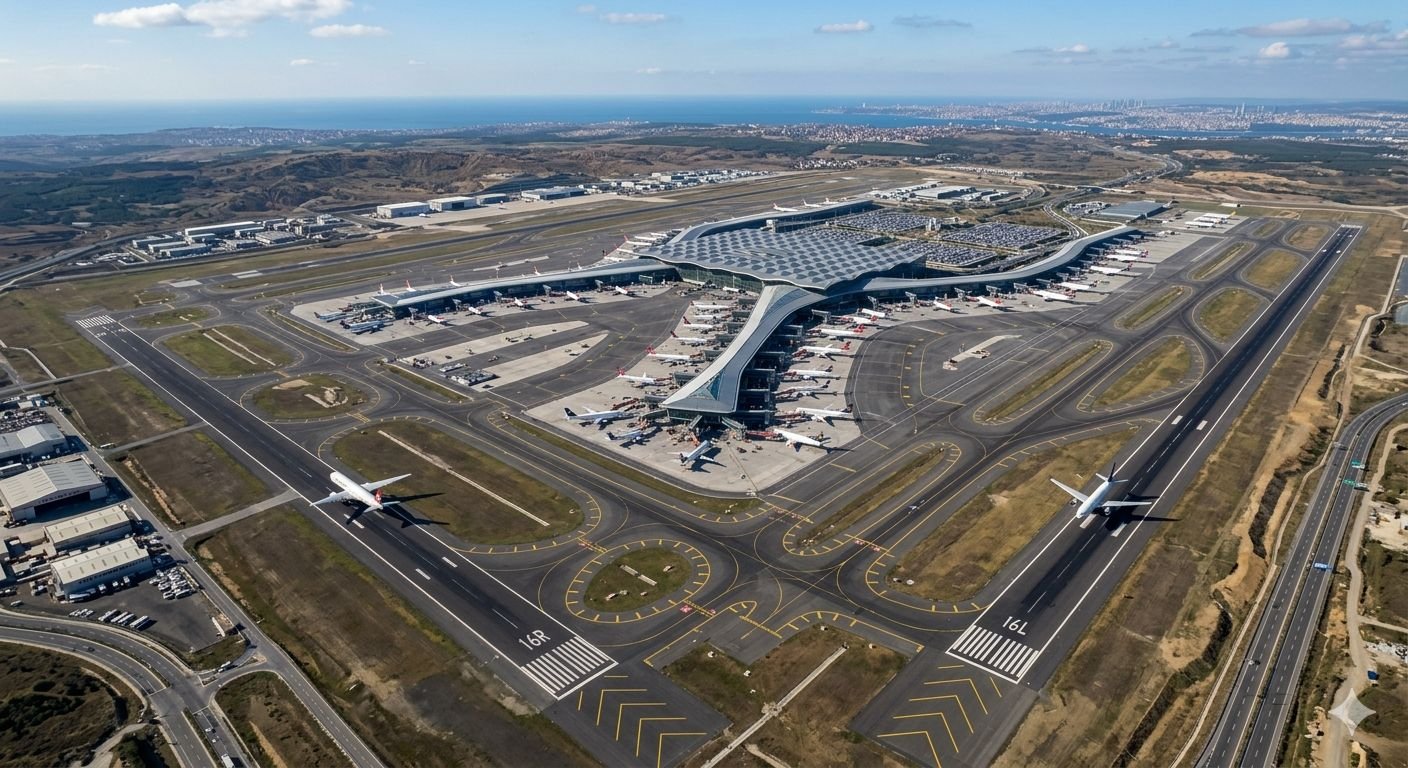
Istanbul Airport (IATA: IST, ICAO: LTFM) is the largest and most important international airport in Turkey and one of the most significant aviation hubs in the world. Serving the historic and strategically located city of Istanbul, the airport connects Europe, Asia, the Middle East, Africa, and the Americas through thousands of domestic and international flights every week.
Since its official opening in 2018 and the complete transfer of commercial operations in 2019, Istanbul Airport has rapidly grown into one of the busiest airports globally. With its modern infrastructure, massive passenger capacity, advanced technology, and strategic location between continents, the airport symbolizes Turkey’s ambition to become a global center for transportation and tourism.
Location and Geography
Istanbul Airport is located in the Arnavutköy district on the European side of Istanbul. The airport lies north of the city center near the Black Sea coast and is positioned between the settlements of Yeniköy, Tayakadın, and Akpınar. It is situated at the intersection of important roads connecting Arnavutköy, Göktürk, and Çatalca.
The airport complex covers approximately 7,600 hectares near Lake Terkos, making it one of the largest airport sites in the world. Around 6,172 hectares of this land previously consisted of state-owned forest areas before development began.
Its geographical position provides major strategic advantages. Istanbul itself sits between Europe and Asia, allowing airlines to reach more than 120 countries within a few hours of flight time. This location has helped Istanbul Airport become a major global transit hub.
History and Development
The idea for a new mega-airport emerged due to the increasing congestion at Atatürk Airport, which had reached its maximum operational capacity. The Turkish government launched the Istanbul Airport project as part of a long-term vision to transform Turkey into a major international aviation center.
Construction officially began in 2015. The airport was designed in multiple phases, with plans for future expansion that could eventually allow it to handle more than 200 million passengers annually.
The first phase officially opened on 29 October 2018, coinciding with the 95th anniversary of the Republic of Turkey. On 6 April 2019, all scheduled commercial passenger flights were transferred from Atatürk Airport to Istanbul Airport, and the IATA code “IST” was reassigned to the new airport.
This transition marked one of the largest airport relocations in aviation history.
Architecture and Design
Istanbul Airport is widely recognized for its impressive modern architecture and large-scale design. The terminal building combines contemporary engineering with elements inspired by traditional Turkish and Islamic architecture.
The main terminal is one of the largest airport terminals under a single roof in the world. The airport features:
- Spacious passenger halls
- Advanced baggage systems
- High-tech security infrastructure
- Luxury lounges
- Large shopping areas
- Hotels and conference facilities
- Smart airport technologies
The control tower design was inspired by the shape of a tulip, one of the traditional symbols of Turkish culture and Istanbul’s Ottoman heritage.
The airport was built with sustainability and efficiency in mind, including energy-saving technologies and environmentally conscious construction practices.
Passenger Traffic and Global Ranking
In recent years, Istanbul Airport has become one of the busiest airports in the world.
In 2023, the airport handled more than 76 million passengers, making it:
- The 2nd-busiest airport in Europe after Heathrow Airport
- The 2nd-busiest airport in the Middle East after Dubai International Airport
- The 7th-busiest airport globally in total passenger traffic
Additionally, according to ACI World statistics, Istanbul Airport served more than 58 million international passengers in 2023, making it the 6th-busiest airport worldwide for international passenger traffic.
These figures demonstrate the airport’s rapid rise as a global aviation powerhouse.
Turkish Airlines Hub
Istanbul Airport serves as the primary hub for Turkish Airlines, the national airline of Turkey and one of the world’s largest international carriers.
Turkish Airlines operates flights from Istanbul to destinations across Europe, Asia, Africa, North America, South America, and Oceania. Thanks to Istanbul Airport’s strategic location, the airline can efficiently connect passengers between continents.
The airport currently offers flights to destinations in approximately 122 countries, making it one of the most internationally connected airports in the world.
Transportation and Accessibility
Istanbul Airport is connected to the city through several transportation options, including:
- Metro lines
- Airport shuttle buses
- Taxis
- Private transfers
- Car rental services
- Highway connections
The airport is directly connected to major highways such as the Kuzey Marmara Motorway (O-7), allowing easier travel between different parts of Istanbul.
The distance between Istanbul Airport and Sabiha Gökçen International Airport on the Asian side of the city is approximately 83.2 kilometers. The journey typically takes around 52 minutes via the Kuzey Marmara Motorway, depending on traffic conditions.
Shopping, Dining, and Passenger Experience
Istanbul Airport offers a premium travel experience with extensive shopping and dining facilities. Inside the terminal, passengers can find:
- International luxury brands
- Duty-free shopping areas
- Turkish restaurants and cafes
- International fast-food chains
- Traditional Turkish cuisine
- VIP lounges
- Relaxation areas
The airport’s duty-free area is among the largest in the world and attracts millions of international travelers every year.
Passengers also benefit from modern digital systems, free Wi-Fi, charging stations, family services, medical facilities, and multilingual assistance.
Economic Importance
The airport plays a vital role in Turkey’s economy by supporting:
- Tourism
- International trade
- Employment
- Cargo transportation
- Foreign investment
As one of the country’s largest infrastructure projects, Istanbul Airport has created thousands of jobs directly and indirectly. It also contributes significantly to Istanbul’s position as a global business and tourism destination.
The airport’s cargo facilities have strengthened Turkey’s role in international logistics and freight transportation between continents.
Future Expansion Plans
Istanbul Airport was designed with future growth in mind. Once all construction phases are completed, the airport is expected to include:
- Multiple additional runways
- Expanded terminal capacity
- Increased cargo operations
- Larger passenger handling systems
Future plans aim for the airport to eventually accommodate up to 200 million passengers annually, potentially making it one of the busiest airports on Earth.
Tourism and Cultural Impact
For many visitors, Istanbul Airport serves as the first impression of Turkey. The airport reflects modern Turkish identity while showcasing aspects of the country’s culture, hospitality, and global ambitions.
Its location in Istanbul — a city historically connecting East and West — reinforces its symbolic role as a bridge between continents, cultures, and civilizations.
Millions of tourists arriving through Istanbul Airport continue onward to famous Turkish destinations such as:
- Cappadocia
- Antalya
- İzmir
- Bodrum
- Bursa
- Trabzon
- Pamukkale
The airport therefore acts not only as a transportation hub but also as a gateway to Turkish tourism and culture.
Istanbul Airport has rapidly become one of the most important aviation centers in the world. Combining modern infrastructure, strategic geographic positioning, high passenger capacity, and global connectivity, the airport represents Turkey’s growing influence in international transportation and tourism.
From its impressive architecture and technological innovation to its role as the main hub of Turkish Airlines, Istanbul Airport continues to shape the future of global aviation. As expansion projects continue and passenger numbers increase, the airport is expected to remain one of the world’s leading transportation hubs for decades to come.