Located approximately 50 kilometers south of Şanlıurfa, near the Syrian border, the Ancient City of Harran is one of the oldest continuously inhabited settlements in the world. With a history stretching back more than 4,000 years, Harran has served as a religious center, a flourishing commercial hub, a seat of learning, and a crossroads of civilizations connecting Mesopotamia with Anatolia and the Mediterranean.
Today, Harran is famous for its unique beehive-shaped mudbrick houses, its impressive medieval ruins, its association with the Prophet Abraham, and its importance in Assyrian, Babylonian, Roman, Islamic, and Ottoman history. The archaeological site forms part of the rich cultural landscape of southeastern Turkey and is included on UNESCO’s Tentative World Heritage List.
A City at the Crossroads of Civilizations
Harran (also spelled Haran) occupies a strategic position on the ancient trade routes linking Nineveh, Carchemish, and the great cities of Mesopotamia. For thousands of years, merchants, pilgrims, scholars, and armies passed through this fertile plain, making Harran one of the most important cities of the ancient Near East.
Archaeological evidence suggests that the city existed as early as 2000 BC, although some scholars believe settlement in the area may be even older. Throughout its long history, Harran came under the control of numerous civilizations, including:
- The Assyrians
- Babylonians
- Persians
- Macedonians
- Romans
- Byzantines
- Umayyads
- Abbasids
- Seljuks
- Ayyubids
- Ottomans
Each left lasting traces that visitors can still explore today.
Harran in the Bible
Harran occupies a prominent place in biblical history.
According to the Book of Genesis, Abraham (Prophet Ibrahim) and his family stopped in Harran after leaving Ur of the Chaldeans on their journey toward the Promised Land. It was here that Abraham’s father, Terah, died before Abraham continued his journey to Canaan.
Because of this connection, Harran is considered sacred by followers of Judaism, Christianity, and Islam, making it one of the world’s oldest pilgrimage destinations.
Local tradition preserves several sites associated with Abraham’s stay, although these traditions are not archaeologically verified.
The Temple of the Moon God Sin
Long before the arrival of the Abrahamic religions, Harran was one of Mesopotamia’s greatest religious centers.
For over a thousand years, the city was famous for the magnificent Temple of Sin, dedicated to the Mesopotamian Moon God Sin (Nanna).
The temple attracted pilgrims from across the ancient Near East and became one of the most influential religious sanctuaries of Assyria and Babylonia.
The deity Sin was commonly represented as:
- A crescent moon
- A long-bearded god
- Wearing a horned crown
Worship of the Moon God continued in Harran until approximately the 6th century AD, long after many neighboring regions had adopted Christianity.
Later, a medieval fortress was constructed over parts of the ancient temple complex.
Capital of the Neo-Assyrian Empire
Following the fall of Nineveh in 612 BC, Harran briefly became the final capital of the Neo-Assyrian Empire.
King Ashur-uballit II attempted to continue Assyrian resistance from Harran, making the city one of the last strongholds of one of history’s greatest empires.
Although the Assyrians ultimately fell to the combined Babylonian and Median armies, Harran retained its regional importance for centuries afterward.
The Battle of Carrhae
One of the most famous events in Roman history occurred near Harran in 53 BC.
The Roman general Marcus Licinius Crassus, one of the members of Rome’s First Triumvirate alongside Julius Caesar and Pompey, led a massive army against the Parthian Empire.
At the Battle of Carrhae, Roman legions suffered one of their greatest defeats.
The Parthian cavalry, using highly skilled mounted archers, overwhelmed the Roman forces. Crassus was killed during the campaign, and thousands of Roman soldiers were either captured or died on the battlefield.
The battle permanently altered the balance of power between Rome and the eastern empires.
Emperor Caracalla’s Assassination
Harran also witnessed another dramatic moment in Roman history.
On 8 April AD 217, Emperor Caracalla was assassinated while traveling near Harran, reportedly after stopping during a journey to visit the sanctuary of the Moon God.
His death marked another turning point in Roman imperial politics and added to Harran’s remarkable historical legacy.
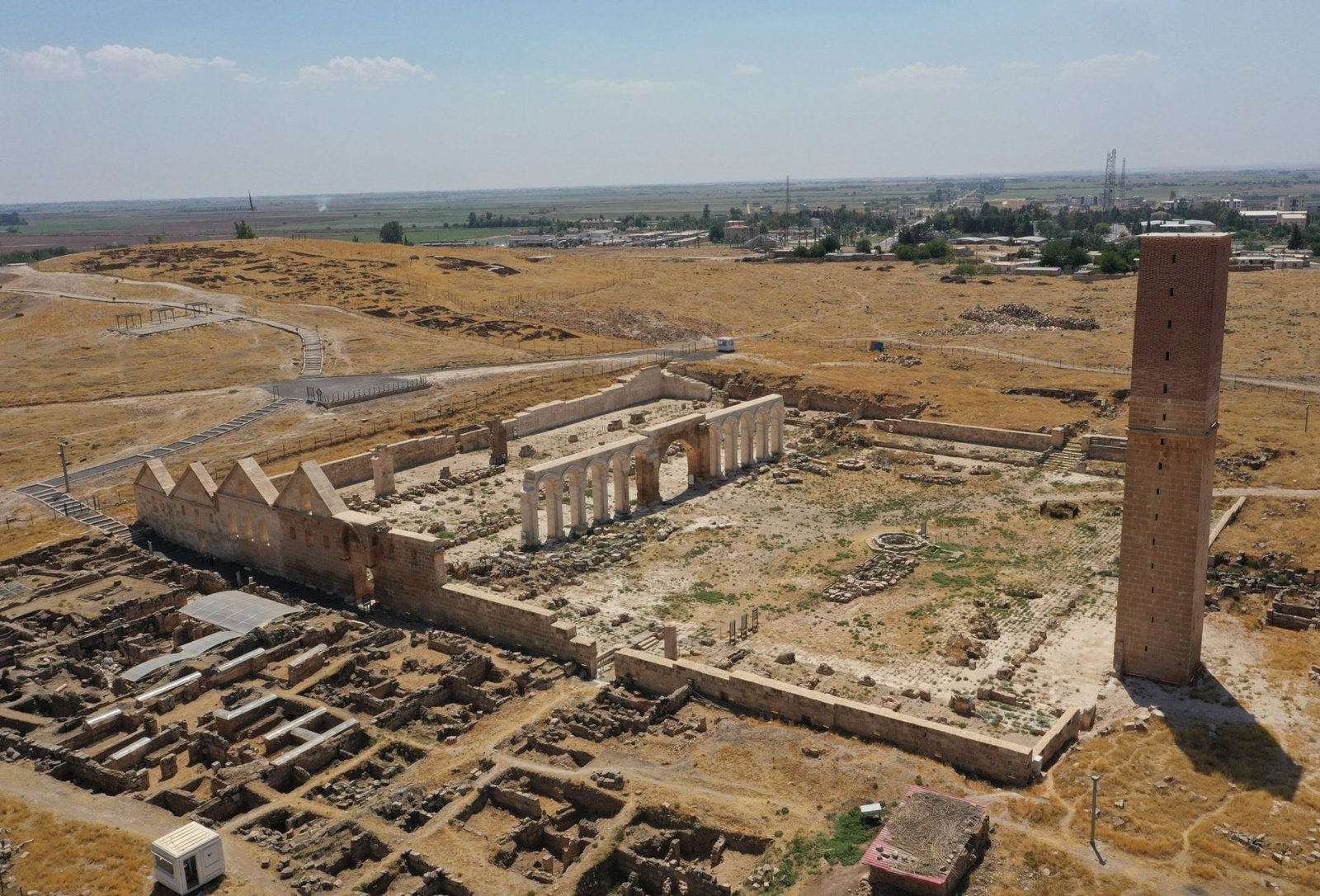
The Great Mosque (Ulu Cami)
One of Harran’s most significant Islamic monuments is the Great Mosque (Ulu Cami).
Constructed during the Umayyad period in the early 8th century, it is regarded as one of the oldest monumental mosques in Anatolia and one of the earliest centers of Islamic education.
Although now largely in ruins, visitors can still admire:
- The remains of the large prayer hall
- Courtyard foundations
- Stone arcades
- Sections of the impressive minaret
- Decorative stonework
The mosque once served not only as a place of worship but also as an important center for scientific learning.
Excavations have also uncovered inscriptions connected with the Babylonian king Nabonidus, which are now displayed in the Şanlıurfa Museum.
Harran University: A Medieval Center of Learning
During the Abbasid period, Harran became one of the Islamic world’s leading intellectual centers.
The famous Harran University, founded in the 8th century, attracted scholars from across the Middle East and became renowned for its studies in:
- Astronomy
- Mathematics
- Medicine
- Philosophy
- Theology
- Natural sciences
Many important Greek scientific works were translated into Arabic here, helping preserve classical knowledge that later reached medieval Europe.
The university remained one of the region’s foremost educational institutions for centuries.
Harran Castle
Dominating the southern part of the archaeological site are the remains of Harran Castle.
The present structure dates largely to the 12th and 13th centuries, although it was built upon much older foundations, possibly including parts of the ancient Temple of Sin.
From its towers, visitors enjoy sweeping views across the vast Harran Plain.
The Ancient City Walls
Harran was once enclosed by impressive defensive walls reinforced with numerous towers.
Originally featuring twelve monumental gates, only five survive today.
Most visible sections date from the medieval Islamic period, although parts incorporate much older masonry from earlier civilizations.
The Famous Beehive Houses
No visit to Harran would be complete without exploring its iconic beehive-shaped houses, perhaps the city’s most recognizable symbol.
Constructed entirely from:
- Sun-dried mud bricks
- Clay mortar
- Straw
- Local stone foundations
these remarkable dwellings have remained virtually unchanged for centuries.
The conical domes, typically standing 4 to 5 meters high, naturally regulate indoor temperatures by keeping interiors cool during the scorching summer months and warm in winter.
Several restored houses now serve as museums, traditional guesthouses, and cultural centers where visitors can learn about local customs, architecture, and daily life.
The Sabians and Ancient Astronomy
For centuries, Harran was also associated with the mysterious Sabians, a religious community renowned for its astronomical knowledge and reverence for celestial bodies.
Their temples, located in the surrounding region, were dedicated to the Sun, Moon, Jupiter, Venus, Saturn, and Mercury.
The Sabian tradition survived remarkably long, reportedly continuing in parts of the Harran region until the 17th century, making it one of the longest-lasting ancient religious traditions in the Near East.
What to See in Harran
Highlights of a visit include:
- Harran Castle
- Great Mosque (Ulu Cami)
- Ancient city walls and gates
- Traditional beehive houses
- Archaeological mound (Tell Harran)
- Ancient streets
- Remains of the Temple of Sin
- Traditional courtyards and village houses
- Harran Cultural House
- Panoramic viewpoints across the Harran Plain
Visiting Harran
Harran is easily reached from Şanlıurfa by car or organized tour and is often combined with visits to:
- Göbekli Tepe
- Şanlıurfa Archaeology Museum
- Balıklıgöl (Pool of Sacred Fish)
- Soğmatar Ancient City
- Bazda Caves
- Halfeti
The best seasons to visit are spring (April–May) and autumn (September–November), when temperatures are pleasant for exploring the archaeological site.
Why Visit Ancient Harran?
Ancient Harran is unlike any other destination in Turkey. Few places combine biblical history, Mesopotamian religion, Roman warfare, Islamic scholarship, and living architectural traditions in such a remarkable setting. From the legendary journey of Abraham and the worship of the Moon God Sin to the Battle of Carrhae and the medieval university that helped preserve classical science, Harran has played a pivotal role in the history of civilization.
Today, wandering through its ancient ruins, climbing the medieval castle, and stepping inside the iconic beehive houses offers visitors an unforgettable experience. Harran is not merely an archaeological site—it is a living testament to thousands of years of human history, faith, knowledge, and cultural exchange at the crossroads of the ancient world.
Leave a Reply
You must be logged in to post a comment.