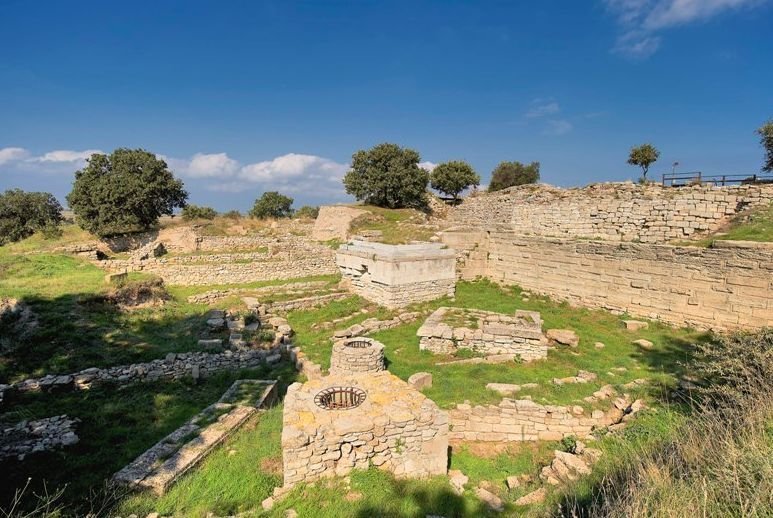
Few archaeological sites have captured the world’s imagination as profoundly as Ancient Troy. Immortalized in Homer’s Iliad and Odyssey, Troy is where history, archaeology, and mythology merge into one of humanity’s greatest stories. Today, the ancient city stands as one of Turkey’s most significant cultural treasures and is recognized as a UNESCO World Heritage Site, attracting hundreds of thousands of visitors each year.
Located near the village of Tevfikiye in Çanakkale Province, northwestern Turkey, the archaeological site occupies the mound of Hisarlık, overlooking the fertile plain of the Scamander (Karamenderes) River, close to the entrance of the Dardanelles Strait where Europe and Asia nearly meet.
Whether you visit because of the legendary Trojan Horse, Homer’s epic poems, or the remarkable archaeological discoveries, Troy offers an unforgettable journey through more than 4,000 years of civilization.
Troy: Between Myth and History
The story of Troy became famous through the epic poems attributed to the ancient Greek poet Homer, who described the legendary Trojan War, fought between the Greeks and the Trojans over the beautiful Helen of Sparta.
According to legend, Prince Paris of Troy abducted Helen, wife of the Spartan king Menelaus, provoking a ten-year war. Unable to conquer the city by force, the Greeks devised the famous Trojan Horse, a gigantic wooden horse hiding Greek soldiers inside. Once brought into the city as a supposed peace offering, the hidden warriors emerged during the night, opened Troy’s gates, and allowed the Greek army to capture the city.
Although many elements remain legendary, archaeological discoveries suggest that Troy was indeed a wealthy and strategically important city that experienced several destructions, one of which may have inspired Homer’s epic.
Discovery of Ancient Troy
For centuries, many scholars believed Troy existed only in myth. That changed in the 19th century when German businessman and amateur archaeologist Heinrich Schliemann began excavating the mound of Hisarlık in 1871, convinced that Homer’s descriptions reflected a real place.
Schliemann uncovered remarkable remains and discovered what he called “Priam’s Treasure.” Although later research showed that the treasure actually belonged to a much earlier period than the Trojan War, his excavations proved that numerous ancient cities had existed on the same site.
Modern archaeology later revealed that Schliemann’s methods were often destructive, as he dug through later layers to reach what he believed was Homer’s Troy. Subsequent excavations led by Wilhelm Dörpfeld, Carl W. Blegen, and more recently Manfred Korfmann greatly improved our understanding of the site.
Today archaeologists recognize nine major cities (Troy I–IX), divided into more than 40 archaeological layers, representing nearly four millennia of continuous occupation.
UNESCO World Heritage Site
Ancient Troy was inscribed on the UNESCO World Heritage List in 1998 because of its exceptional archaeological importance and its enormous influence on literature, art, and Western civilization.
The site demonstrates continuous human settlement from approximately 3000 BC until the Byzantine period, making it one of the longest-inhabited archaeological sites in the eastern Mediterranean.
The Nine Cities of Troy
Troy I (c. 3000–2550 BC)
The earliest Bronze Age settlement occupied a relatively small fortified hilltop. Houses were constructed using sun-dried mud bricks on stone foundations. Despite its modest size, impressive defensive walls suggest that the settlement already held regional importance.
Troy II (c. 2550–2300 BC)
Troy II expanded considerably and became a prosperous commercial center. Carefully planned streets, large megaron-style houses, and impressive fortifications characterized this phase.
Schliemann mistakenly believed this was the Troy of King Priam and discovered the famous “Priam’s Treasure” here. Modern dating, however, shows that Troy II existed nearly one thousand years before the legendary Trojan War.
The city was eventually destroyed by a devastating fire.
Troy III, IV and V (2300–1750 BC)
Following the destruction of Troy II, several successive settlements arose.
During these periods:
- Houses became larger and more sophisticated.
- Stone construction techniques improved.
- Residential neighborhoods expanded.
- Defensive walls were repeatedly rebuilt and strengthened.
These centuries reflect gradual cultural development rather than dramatic historical events.
Troy VI (c. 1750–1300 BC)
Many archaeologists consider Troy VI to represent the city’s greatest architectural achievement.
The city featured:
- Massive limestone defensive walls
- Monumental gates
- Well-planned streets
- Multi-room stone houses
- Sophisticated drainage systems
Its imposing fortifications suggest that Troy had become a wealthy and powerful regional kingdom controlling important trade routes through the Dardanelles.
Around 1300 BC, much of the city appears to have been destroyed, possibly by a major earthquake.
Troy VIIa (c. 1300–1180 BC)
Built directly upon the ruins of Troy VI, this settlement is considered by many archaeologists—including Carl Blegen—to be the strongest candidate for the Troy described in Homer’s Iliad.
Evidence includes:
- Houses crowded closely together.
- Large storage jars (pithoi) buried beneath floors for food supplies.
- Signs of hurried rebuilding.
- Burn layers and evidence of violent destruction.
These findings suggest a city under siege, matching aspects of the legendary Trojan War.
Troy VIIb (1180–950 BC)
New settlers introduced different architectural styles after Troy VIIa’s destruction. Buildings became simpler, and cultural influences from southeastern Europe became more apparent.
Eventually this settlement also declined following another destructive fire.
Troy VIII (700–85 BC)
Although often overlooked, Troy flourished again during the Greek period.
The city became an important religious center dedicated to Athena, with pilgrims visiting the sanctuary from across the Greek world.
Alexander the Great reportedly visited Troy in 334 BC before launching his campaign against Persia, paying homage at the supposed tomb of Achilles.
Troy IX (85 BC – AD 500)
Under Roman rule, Troy—known as Ilion—experienced its final great period of prosperity.
The Romans believed they descended from the Trojan hero Aeneas, making Troy an important symbolic city throughout the Roman Empire.
Major public buildings included:
- The Temple of Athena
- A large Roman theatre
- The Bouleuterion (Council House)
- Public baths
- An odeon
- Monumental gateways
- Expanded defensive walls
The city remained inhabited well into the Byzantine era before gradually being abandoned.
What to See at Ancient Troy
Although much of Troy consists of archaeological foundations, visitors can still appreciate the scale and significance of this extraordinary city.
Highlights include:
- The famous wooden Trojan Horse replica near the entrance.
- The mighty defensive walls of Troy VI.
- The East Gate and South Gate.
- Ancient city walls spanning several periods.
- The Temple of Athena.
- Roman theatre remains.
- The Bouleuterion.
- Excavated residential quarters.
- Ancient stone ramps and gateways.
- Information panels explaining each archaeological layer.
Walking through the site allows visitors to literally move through over four thousand years of history.
Troy Museum
Just a short distance from the archaeological site is the award-winning Troy Museum, one of Turkey’s finest archaeological museums.
Its modern exhibitions display:
- Gold jewelry
- Pottery
- Marble sculptures
- Weapons
- Coins
- Ceramics
- Interactive digital reconstructions
- Finds from Troy and the surrounding Troad region
The museum provides essential context before or after exploring the ruins and greatly enhances the visitor experience.
The Legendary Trojan Horse
Although no archaeological evidence confirms the existence of the Trojan Horse, it remains one of the most recognizable symbols in world literature.
Visitors will find a large wooden reconstruction standing near the entrance to the archaeological site. Another famous wooden horse, built for the 2004 Hollywood film Troy, is displayed along the Çanakkale waterfront.
Together they celebrate one of history’s most enduring legends.
Visiting Ancient Troy
The archaeological site lies approximately:
- 30 km southwest of Çanakkale
- Around 5 hours by road from Istanbul
- Easily accessible by car or organized tours
Most visitors combine Troy with nearby attractions such as Gallipoli, Assos, Bozcaada Island, or the city of Çanakkale.
Allow at least 2–3 hours to explore the ruins and another 1–2 hours for the Troy Museum.
Why Visit Ancient Troy?
Ancient Troy is far more than the setting of an epic poem. It represents thousands of years of human civilization, trade, warfare, architecture, and cultural exchange. Every layer tells the story of a different era, from the Bronze Age to the Roman Empire.
Whether you are fascinated by archaeology, Greek mythology, ancient history, or simply wish to stand where one of the world’s greatest legends was born, Troy offers an unforgettable experience. Walking among its ancient walls, visitors discover not only the remains of a remarkable city but also the origins of stories that have inspired humanity for nearly three thousand years.
Leave a Reply
You must be logged in to post a comment.