Located south of Ephesus, the ancient city of Priene offers an exceptional insight into what a well-planned city of the 4th century BC looked like. Situated approximately 15 kilometers southwest of Söke in Aydın Province, on the southern slopes of Mount Mykale (Samsun Dağı), Priene is one of the most remarkable archaeological sites in western Türkiye.
The city is particularly important because its streets, residential blocks, public buildings and temples have survived in a remarkably coherent urban layout. Priene is therefore considered one of the best-preserved examples of ancient Greek urban planning and provides valuable evidence for understanding the development of organized city planning in Anatolia.
Where Is Priene?
Priene is located in the Aegean region of Türkiye, within the boundaries of modern-day Aydın Province and close to the town of Söke.
The ancient city occupies a hillside overlooking the former plain of the Büyük Menderes River. Its elevated position provided natural protection and offered extensive views across the surrounding landscape.
The site is also strategically located near several major archaeological and historical attractions, including Ephesus, Miletus, Didyma and the natural landscapes around the Büyük Menderes Valley.
Because of its location, Priene can easily be included in a broader archaeological tour of western Türkiye.
History of Priene
Priene was an ancient Greek city associated with the Ionian League, one of the important political and cultural associations of the cities of Ionia.
Ancient sources mention Priene as early as the 7th century BC. The city’s early history, however, is complex, and its settlement was relocated before the establishment of the city that visitors see today.
The most important phase in Priene’s history began during the 4th century BC, when the city was rebuilt according to a carefully organized urban plan associated with the famous urban planner Hippodamus of Miletus.
This period transformed Priene into one of the clearest examples of planned Hellenistic urbanism in Anatolia.
The city later continued to exist during the Hellenistic and Roman periods. During the Byzantine period, Priene became an episcopal center.
Over time, however, the geography surrounding the city changed dramatically. Sediment carried by the Büyük Menderes River gradually filled the ancient gulf and pushed the coastline farther away from Priene.
As the city lost its direct access to the sea, its economic and strategic importance declined.
Priene was eventually abandoned, and by the 13th century the settlement had effectively ceased to function as a city.
Priene and Hippodamus’ Urban Planning
One of the most important reasons Priene is archaeologically significant is its exceptionally clear urban plan.
The city is associated with the planning principles attributed to Hippodamus of Miletus, whose approach divided urban areas into organized blocks using streets that intersected at approximately right angles.
This system is often described as a grid plan.
The main streets of Priene generally run east-west, while secondary streets cross them in a north-south direction. The resulting pattern creates a series of rectangular urban blocks known as insulae.
This organization was not merely decorative. The relationship between the streets, houses and terrain demonstrates a sophisticated understanding of urban planning.
The city was laid out on a steep hillside, and the planners adapted the grid system to the natural topography. Streets were arranged in terraces, creating an organized urban landscape despite the difficult terrain.
Why Priene Is Important for Urban Planning
Priene provides an unusually clear picture of how an ancient planned city was organized.
The city demonstrates how different functions could be integrated into one coherent urban system. Residential areas, religious buildings, public institutions, marketplaces, theaters, gymnasia and open spaces were positioned within the same overall plan.
This makes Priene particularly valuable for understanding the development of urban planning in the ancient Mediterranean.
The city is also important because many of its residential blocks remain recognizable. Visitors can still see the relationship between streets, houses and public buildings rather than viewing isolated monuments scattered across an archaeological landscape.
The Houses of Priene
The residential buildings are among the most fascinating remains at Priene.
The houses provide valuable information about daily life during the Late Classical and Hellenistic periods. Their remains show how domestic architecture was integrated into the wider urban plan.
Many houses were organized around internal courtyards, with rooms arranged according to specific domestic functions.
The preservation of these residential structures allows archaeologists to study not only monumental architecture but also the everyday environment of ancient inhabitants.
For this reason, Priene is sometimes described as the “Pompeii of Anatolia”, particularly because its relatively well-preserved residential quarters provide an unusually detailed picture of ancient urban life.
Priene Theatre
The Theatre of Priene is one of the most impressive monuments at the site and one of the best-preserved examples of an ancient Greek theater in Anatolia.
The theater was constructed during the 4th century BC and was adapted and renovated during later periods.
Built into the natural slope of the hillside, the theater takes advantage of the terrain to create a large seating area facing the performance space.
The original theater could accommodate approximately 5,000 spectators.
Its horseshoe-shaped seating arrangement and relationship with the surrounding landscape provide an excellent example of ancient Greek theater architecture.
Visitors can still see the seating rows, stage-related structures and other architectural elements.
Temple of Athena Polias
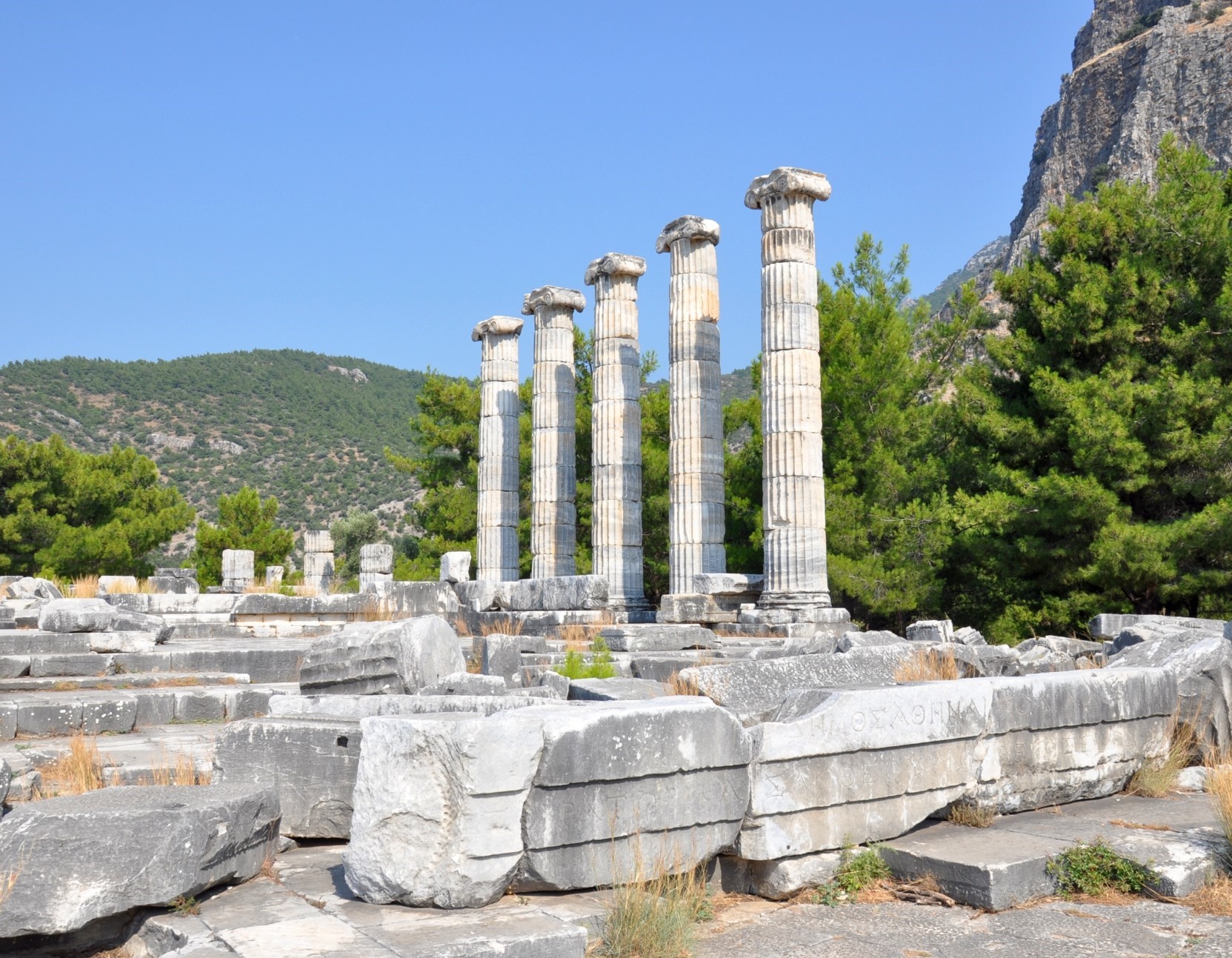
The Temple of Athena Polias is one of Priene’s most important monuments.
Situated prominently on the hillside, the temple was designed by the renowned architect Pytheos, who is also associated with the Mausoleum at Halicarnassus.
The temple was dedicated to Athena, the city’s patron goddess, and represents one of the significant achievements of Ionian architecture.
Its design contributed to the development and understanding of architectural principles that became influential in the classical tradition.
The location of the temple is particularly impressive. Positioned high above the surrounding plain, it offers broad views toward the Büyük Menderes Valley.
The Agora
The agora was the civic and commercial heart of ancient Priene.
Public life in Greek cities often centered around the agora, where commerce, political activity and social interaction took place.
At Priene, the agora formed an important part of the overall city plan and was connected to the surrounding streets and public buildings.
Walking through the remains of the agora provides a better understanding of how the ancient city functioned as a community rather than simply as a collection of monuments.
Bouleuterion
The Bouleuterion was one of the city’s important political buildings.
It was used for meetings of the city council and illustrates the importance of organized civic institutions in ancient Greek urban life.
The building’s position within the city plan demonstrates how political functions were integrated into the broader urban structure.
Temple of Zeus
Another important religious structure in Priene was the Temple of Zeus.
Although its remains are less visually dominant than those of the Temple of Athena, the temple contributes to the understanding of the city’s religious landscape and the variety of cults practiced in Priene.
Temple of Demeter
The Temple of Demeter is another significant religious structure.
Demeter was associated with agriculture, fertility and the cultivation of crops, making her worship particularly meaningful in an agricultural region.
The sanctuary provides another example of the diversity of religious life in ancient Priene.
Gymnasia
Priene had both an Upper Gymnasium and a Lower Gymnasium, reflecting the importance of physical education and intellectual development in ancient Greek society.
Gymnasia were not simply places for athletic training. They could also function as social and educational institutions.
The remains therefore provide valuable evidence about the daily life and education of the city’s inhabitants.
Temple of the Egyptian Gods
The presence of a sanctuary dedicated to Egyptian deities demonstrates the cultural diversity of the Hellenistic world.
During the Hellenistic period, religious ideas and cults spread across the eastern Mediterranean, and Priene participated in this wider cultural exchange.
The Temple of the Egyptian Gods is therefore important not only architecturally but also historically.
The House Associated with Alexander the Great
One of the interesting structures identified within Priene is a house traditionally associated with Alexander the Great.
The association has contributed to the site’s historical appeal, although visitors should distinguish between archaeological evidence and later traditional identifications.
Priene’s location within the Hellenistic world and its connection with the political developments of the period make Alexander’s presence an important part of the site’s historical narrative.
Byzantine Priene
Although Priene is particularly famous for its Classical and Hellenistic remains, the city continued to exist into the Byzantine period.
During this period, Priene became an episcopal center and a Christian community developed within the ancient settlement.
The remains of a Byzantine church demonstrate the transformation of the city from a predominantly pagan Greek and Hellenistic settlement into a Christian urban community.
This later history adds another layer to Priene’s archaeological significance.
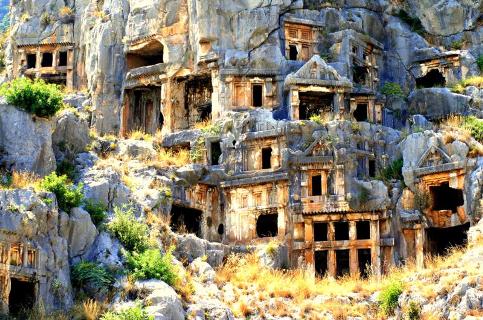
The Necropolis
The ancient city’s necropolis provides evidence about burial practices and the social structure of Priene.
Tombs and funerary remains located outside the main urban area illustrate how ancient communities organized the relationship between the world of the living and the world of the dead.
The necropolis is therefore an important part of understanding Priene beyond its monumental buildings.
Priene and the Changing Coastline
One of the most fascinating aspects of Priene’s history is the transformation of its landscape.
When the city flourished, it was located much closer to the sea. The Büyük Menderes River, however, continuously deposited sediment into the ancient gulf.
Over centuries, the coastline moved progressively farther away.
The once-important relationship between Priene and the sea gradually disappeared, contributing to the city’s economic decline.
Today, the ancient city’s elevated position provides a striking reminder of how dramatically landscapes can change over historical time.
Priene as an Archaeological Site
Unlike some ancient cities where individual monuments dominate the visitor experience, Priene is particularly valuable because its urban structure remains visible.
Visitors can walk through ancient streets and understand the relationship between:
- Residential houses
- Temples
- Public buildings
- Agora
- Theater
- Gymnasia
- Religious sanctuaries
- Civic institutions
- Necropolis
This makes Priene an excellent archaeological destination for anyone interested in ancient architecture, urban planning and everyday life.
What to See at Priene
A visit to Priene should include the following major areas:
- Temple of Athena Polias – The city’s most prominent religious monument.
- Ancient Theatre – One of the best-preserved Greek theaters in Anatolia.
- Agora – The civic and commercial center of the ancient city.
- Bouleuterion – The meeting place of the city council.
- Upper Gymnasium – An important educational and athletic complex.
- Lower Gymnasium – Another major public institution.
- Temple of Demeter – An important religious sanctuary.
- Temple of Zeus – Another component of the city’s religious landscape.
- Temple of the Egyptian Gods – Evidence of Hellenistic religious diversity.
- Ancient Houses – Valuable examples of domestic architecture.
- Byzantine Church – Evidence of the city’s later Christian period.
- Necropolis – The ancient burial area.
Priene, Miletus and Didyma
Priene is particularly rewarding when visited together with other ancient sites in the region.
The nearby ancient city of Miletus was one of the most important intellectual and political centers of ancient Ionia and is closely associated with Hippodamus.
Didyma, famous for the enormous Temple of Apollo, is another major archaeological destination in the region.
A combined itinerary covering Priene, Miletus and Didyma allows visitors to explore the political, religious, architectural and intellectual history of ancient Ionia.
Priene and Ephesus
Ephesus is considerably larger and more monumental than Priene, but the two sites offer very different experiences.
Ephesus provides monumental streets, temples, libraries and large public structures within a major ancient metropolis.
Priene, by contrast, offers a more intimate view of a planned Greek city and allows visitors to understand the relationship between individual buildings and the overall urban layout.
For travelers interested in ancient urban planning, visiting both sites provides an excellent comparison.
Best Time to Visit Priene
Spring and autumn are generally the most comfortable periods for exploring Priene.
During these seasons, temperatures are usually more suitable for walking through the archaeological site, while the surrounding landscape can be particularly attractive.
Summer visits are also possible, but temperatures in the Aegean region can be high. Because much of the archaeological site is exposed to the sun, visitors should carry:
- Water
- Sun protection
- A hat
- Comfortable walking shoes
- Sunglasses
Early morning or late afternoon can be more comfortable during the hottest months.
How Long Should You Spend at Priene?
A typical visit can take approximately 1.5 to 3 hours, depending on how deeply you explore the archaeological remains.
Visitors primarily interested in the major monuments may need less time, while those interested in architecture, urban planning and the residential quarters may wish to spend several hours exploring the site.
Photography enthusiasts may also want additional time because the elevated location provides attractive views across the surrounding landscape.
Why Visit Priene?
Priene is particularly rewarding for travelers who want more than a conventional archaeological sightseeing experience.
The site combines:
- Ancient Greek history
- Hellenistic architecture
- Urban planning
- Religious history
- Domestic architecture
- Byzantine heritage
- Mountain scenery
- Archaeology
- Landscape history
Its greatest attraction is perhaps the fact that the ancient city can still be understood as a city rather than simply as a group of ruins.
The streets, houses, public buildings and temples remain connected within an identifiable urban plan.
Priene is one of the most remarkable ancient cities in western Türkiye and one of the finest surviving examples of planned ancient urbanism.
Its association with Hippodamus, its carefully organized grid plan, its hillside setting and its exceptionally informative residential quarters make it an invaluable archaeological site.
The Temple of Athena Polias, ancient theater, agora, bouleuterion, gymnasia, temples, houses, Byzantine church and necropolis together provide a remarkably complete picture of urban life from the Classical and Hellenistic periods through the Byzantine era.
Perhaps the most fascinating aspect of Priene is the way history and landscape come together. A city that was once closely connected to the sea gradually found itself farther inland as the Büyük Menderes River deposited sediment along the ancient gulf. The changing landscape eventually contributed to the decline and abandonment of the settlement.
Today, Priene offers visitors the opportunity to walk through an ancient planned city, study its architecture and appreciate the extraordinary relationship between human settlement and the natural environment.
For anyone interested in ancient history, archaeology, Greek architecture, urban planning and cultural tourism, Priene is one of the essential archaeological destinations of the Aegean region.