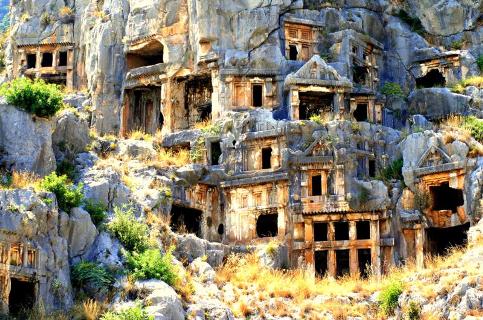
Nestled near the modern town of Demre on Türkiye’s Mediterranean coast, the Ancient City of Myra is one of the most remarkable archaeological sites of the ancient Lycian civilization. Famous for its magnificent rock-cut tombs, impressive Roman theatre, and strong connections to early Christianity, Myra attracts thousands of history enthusiasts and travelers each year.
Set against dramatic limestone cliffs overlooking the fertile Demre plain, Myra offers visitors an unforgettable glimpse into more than 2,000 years of history.
A Powerful City of Ancient Lycia
Myra was one of the principal cities of the Lycian League, a federation of prosperous city-states in southwestern Anatolia. Archaeological evidence suggests that the settlement flourished from at least the 5th century BCE, although the area may have been inhabited much earlier.
Thanks to its strategic location near the Mediterranean Sea, Myra became an important center for trade, politics, and religion. The city reached the height of its prosperity during the Roman period, when it grew into one of the wealthiest and most influential cities in the region.
Ancient inscriptions, monumental tombs, temples, and public buildings reveal the city’s importance throughout classical antiquity.
The Magnificent Lycian Rock Tombs
The highlight of any visit to Myra is its extraordinary collection of Lycian rock-cut tombs, carved high into the towering cliffs overlooking the ancient city.
These elaborate burial chambers were carved directly into the limestone and designed to resemble wooden houses and temples. The Lycians believed that burying the dead high above the ground would allow their souls to be carried more easily to the heavens by mythical winged creatures.
Many of the tomb façades feature beautifully preserved columns, relief carvings, decorative pediments, and inscriptions, making them among the finest examples of Lycian funerary architecture found anywhere in Türkiye.
A short climb allows visitors to admire these remarkable monuments from closer viewpoints while enjoying panoramic views across the archaeological site.
One of the Best-Preserved Roman Theatres in Türkiye
At the foot of the cliffs stands Myra’s impressive Roman theatre, considered one of the best-preserved ancient theatres in the country.
Originally constructed during the Hellenistic period and later expanded under Roman rule, the theatre features:
- 29 tiers of seating
- Capacity for approximately 9,000–10,000 spectators
- Exceptionally preserved stage building
- Decorative stone reliefs and theatrical masks
- Excellent acoustics
The theatre once hosted dramatic performances, public meetings, religious ceremonies, and civic celebrations. Today, it remains one of the architectural highlights of the ancient city and is occasionally used for cultural events and concerts.
Myra During the Roman and Byzantine Periods
During the Roman Empire, Myra continued to flourish as an important administrative and commercial center.
Historical sources record that Germanicus, the adopted son of Emperor Tiberius, visited the city with his wife Agrippina the Elder in the 1st century CE, reflecting Myra’s growing prestige within the Roman world.
By the 2nd century CE, Myra had become the leading city of Lycia and was granted the status of a metropolitan center.
Under Byzantine rule, particularly during the 4th and 5th centuries, Myra developed into one of the region’s most important Christian centers, serving as both a religious and administrative capital.
Saint Nicholas and Early Christianity
Myra is closely associated with Saint Nicholas, the 4th-century Bishop of Myra, whose generosity and compassion inspired the modern legend of Santa Claus.
His nearby church in Demre became one of the most important pilgrimage destinations in the Byzantine world and continues to attract visitors from around the globe.
The city is also linked to Saint Paul, who is believed to have stopped at Myra during one of his missionary journeys while traveling to Rome, as described in the New Testament.
Visiting the Ancient City Today
Today, the Ancient City of Myra is one of the most visited archaeological attractions along Türkiye’s Mediterranean coast.
Visitors can explore:
- The spectacular Lycian rock tombs
- The magnificent Roman theatre
- Ancient inscriptions and relief carvings
- Roman streets and public buildings
- Byzantine remains
- Scenic viewpoints overlooking the Demre plain
The site is well maintained and easily accessible, making it a popular stop on cultural tours between Antalya, Kaş, Kekova, and Fethiye.
Nearby Attractions
A visit to Myra can easily be combined with several nearby attractions, including:
- The Church of Saint Nicholas in Demre
- Kekova Island and its famous Sunken City
- Simena (Kaleköy)
- Andriake Ancient Harbour
- Çayağzı Beach
- The Lycian Way hiking trail
Why Visit Myra?
The Ancient City of Myra offers an exceptional combination of history, archaeology, architecture, and religious heritage. From its breathtaking Lycian rock tombs carved into soaring cliffs to its remarkably preserved Roman theatre and its connection with Saint Nicholas, Myra is one of Türkiye’s most rewarding archaeological destinations.
Whether you are fascinated by ancient civilizations, early Christianity, or simply wish to explore one of the Mediterranean’s most beautiful historical landscapes, Myra promises an unforgettable journey through the rich heritage of ancient Lycia.
Leave a Reply
You must be logged in to post a comment.