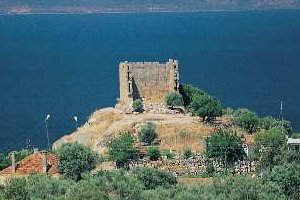
Located on the northeastern shore of Lake Bafa in Muğla Province, the Ancient City of Herakleia under Latmus (Herakleia ad Latmum) is one of the most fascinating archaeological sites of the Aegean region. Surrounded by dramatic rocky mountains, ancient olive groves, and the peaceful waters of Lake Bafa, Herakleia offers a unique combination of history, mythology, archaeology, and natural beauty.
Once located on the shores of the Latmian Gulf, an arm of the Aegean Sea, the city gradually became an inland settlement after the Menderes (Maeander) River carried sediment into the gulf and transformed the coastline into what is now Lake Bafa.
Today, the ruins of Herakleia stand as a remarkable reminder of ancient Carian civilization and the later Christian monastic traditions that flourished among the mountains surrounding the lake.
From Latmus to Herakleia
The earliest name of the settlement was Latmus, derived from Mount Latmus, the impressive mountain range overlooking the city and rising to approximately 1,300 meters above sea level.
Although Herakleia was situated within the cultural region of Ionia, it remained strongly Carian in character. Its history was closely connected with the political developments of ancient Caria rather than the major Ionian coastal cities.
Unlike nearby cities such as Ephesus and Miletus, Herakleia never became a major commercial center because it was located away from the principal trade route connecting Ephesus and Miletus. Miletus, with its powerful fleet and strategic harbor, dominated maritime commerce in the region.
The Transformation Under King Mausolus
During the 4th century BC, the powerful Carian ruler Mausolus of Halicarnassus expanded his influence throughout the region.
Using political strategy and military tactics, Mausolus gained control over Latmus as part of his efforts to strengthen and Hellenize Caria.
The city was renamed Herakleia under Latmus to distinguish it from the many other ancient cities named Herakleia throughout the Greek world.
The new name honored Herakles (Hercules), one of the most celebrated heroes of Greek mythology.
Lysimachus and the Great City Walls
After the death of Alexander the Great, his generals divided his vast empire among themselves.
In 287 BC, Lysimachus, one of Alexander’s most powerful successors, took control of Herakleia and transformed it into a heavily fortified Hellenistic city.
The most impressive surviving feature of Herakleia is its enormous defensive wall system.
These fortifications:
- Extend for nearly 6 kilometers
- Include approximately 65 towers
- Follow the difficult mountainous terrain
- Rise from the lakeshore to elevations of nearly 500 meters
The massive stone walls remain among the best-preserved examples of Hellenistic military architecture in western Anatolia.
Walking along these ancient defenses provides spectacular views over Lake Bafa and the surrounding mountains.
The Temple of Athena
One of Herakleia’s most important monuments is the Temple of Athena, located on a rocky promontory overlooking the lake.
Built during the Hellenistic period, the temple was designed in the in antis style, where the walls of the temple extend forward to form a small porch between two columns.
Dedicated to Athena, the goddess of wisdom and strategic warfare, the temple reflected the city’s Greek cultural influences while remaining part of the Carian landscape.
Today, visitors can still see the temple foundations, architectural fragments, and column remains against the spectacular backdrop of Lake Bafa.
Hippodamian City Planning
Herakleia was designed according to the Hippodamian urban planning system, named after Hippodamus of Miletus, the famous Greek architect and city planner.
This system organized cities using:
- Straight streets
- Rectangular city blocks
- Planned public areas
- Functional separation of residential and civic spaces
The same planning principles were used in several important Greek and Hellenistic cities throughout the Mediterranean world.
The Decline of Herakleia
Herakleia enjoyed prosperity during the Hellenistic period, but its importance gradually declined during Roman times.
The main reason was environmental change.
The Maeander (Menderes) River deposited large amounts of sediment into the Latmian Gulf, eventually cutting Herakleia off from direct access to the sea.
The loss of its harbor severely affected trade and reduced the city’s economic importance.
By the late Roman period, Herakleia had become a quieter regional settlement rather than a major commercial center.
Byzantine Monastic Heritage of Latmus Mountain
During the Byzantine period, the region surrounding Herakleia gained new importance as a center of Christian monasticism.
From the 7th century onward, monks and hermits seeking spiritual isolation settled in the caves and rocky valleys of Mount Latmus.
The rugged landscape, with hundreds of natural caves and secluded valleys, provided ideal conditions for monastic life.
Some monks became highly respected spiritual figures, attracting pilgrims from distant regions.
The monastic tradition of Latmus continued for nearly four centuries, creating a remarkable landscape filled with:
- Cave churches
- Rock shelters
- Monastic settlements
- Byzantine frescoes
The Legend of Endymion
One of the most fascinating legends connected with the region is the story of Endymion, a beautiful shepherd or hunter from Greek mythology.
According to ancient mythology, Endymion was loved by the moon goddess Selene, who asked Zeus to grant him eternal sleep so that he could remain forever young.
A local tradition later associated a cave sanctuary on Mount Latmus with the supposed tomb of Endymion.
Early Christian communities adapted the sacred site, transforming it into a place of Christian worship.
This blending of pagan mythology and Christian tradition reflects the extraordinary cultural continuity of Anatolia.
Visiting Herakleia Today
The Ancient City of Herakleia is located near the modern village of Kapıkırı, beside Lake Bafa.
Visitors can explore:
- The massive Hellenistic city walls
- Defensive towers
- Temple of Athena
- Agora remains
- Ancient harbor structures
- Necropolis
- Byzantine churches
- Rock monasteries
- Cave settlements
The surrounding area is equally impressive, offering opportunities for:
- Hiking on Mount Latmus
- Birdwatching around Lake Bafa
- Photography
- Boat trips
- Exploring traditional villages
- Discovering ancient olive groves
Nearby Attractions
Herakleia is ideally located for exploring other historical and natural attractions:
- Lake Bafa Nature Park
- Latmos Mountains
- Beşparmak Mountains
- Ancient City of Miletus
- Ancient City of Didyma
- Priene Ancient City
- Milas
- Bodrum Peninsula
A Hidden Gem of Ancient Caria
The Ancient City of Herakleia under Latmus is one of Turkey’s most atmospheric archaeological destinations. Its powerful Hellenistic walls, sacred Temple of Athena, Carian heritage, and Byzantine cave monasteries reveal a landscape where different civilizations lived, worshipped, and transformed the same mountains for more than two thousand years.
Standing beside the peaceful waters of Lake Bafa, surrounded by the ancient rocks of Mount Latmus, visitors experience not only an archaeological site but a living cultural landscape where mythology, history, and nature remain deeply connected.
Leave a Reply
You must be logged in to post a comment.