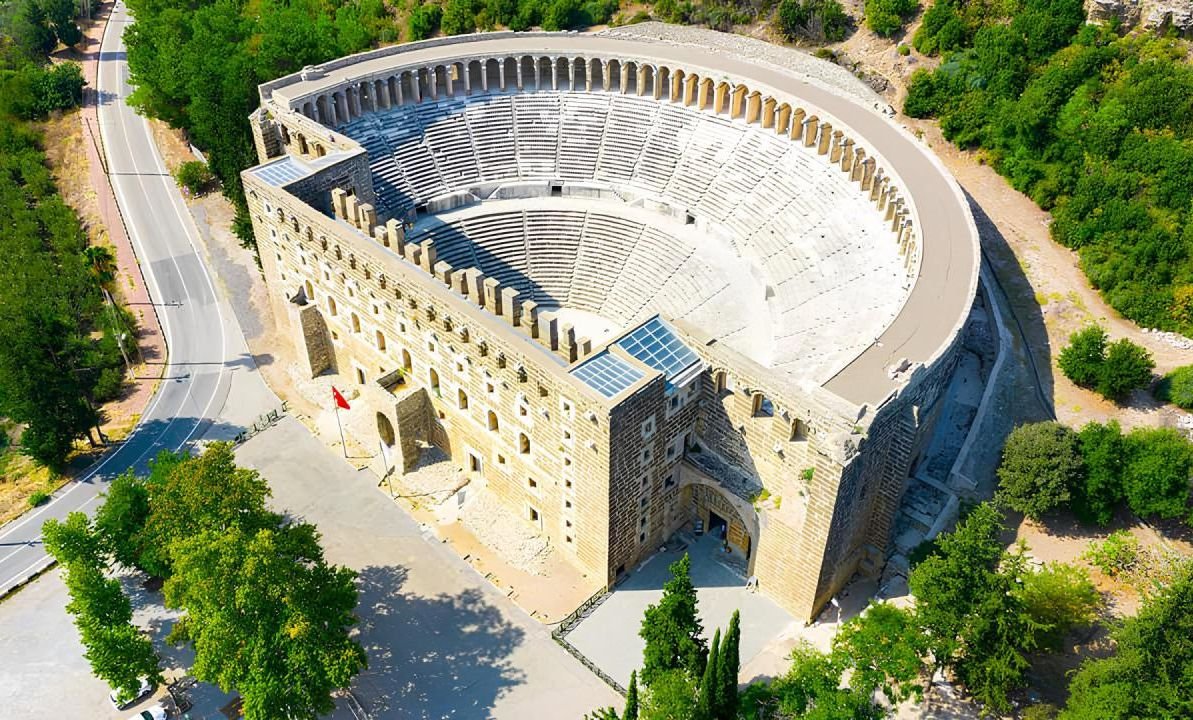
Aspendos Ancient Theatre is one of the most famous and best-preserved ancient theatres in the world. Located in the Antalya region of southern Turkey, Aspendos is an exceptional example of Roman architecture and remains one of the most impressive archaeological attractions in the country.
Aspendos can be reached by an asphalt road branching off the Antalya–Manavgat highway. The ancient city is located near the Köprüçay River, approximately 8 kilometers east of Serik, where the river emerges from the mountainous terrain and reaches the plains.
According to tradition, Aspendos was founded in the 10th century BC by the Achaeans. Over the centuries, it developed into one of the prosperous and well-developed cities of the ancient world.
The History of Aspendos
Aspendos has a long and complex history extending back to the ancient civilizations of Anatolia.
Ancient writers such as Strabo and Pomponius Mela mention the city in their works and provide information about its origins and geographical importance.
Greek migrations into the region increased after approximately 1200 BC. However, the name Aspendos is generally considered to have originated from an indigenous Anatolian language that existed before the arrival of Greek settlers.
The city’s location played a major role in its development. Aspendos stood on an important trade route and was connected to the Mediterranean coast through the Köprüçay River.
Because of this strategic position, Aspendos was an important economic center and was repeatedly sought after by different powers throughout history.
The Location of Aspendos
Aspendos was built on and around two hills, with the main urban area occupying the larger hill and important structures extending toward the surrounding plain.
Its location provided both strategic advantages and access to the fertile lands around the Köprüçay River.
The river also played an important role in trade. Although the ancient coastline was closer to the city than it is today, changes in the river’s course and the accumulation of sediments gradually altered the relationship between Aspendos and the Mediterranean coast.
Aspendos Ancient Theatre
The most famous structure in Aspendos is undoubtedly its ancient theatre.
Built during the Roman period in the 2nd century AD, the theatre is regarded as one of the best-preserved Roman theatres in the Mediterranean world.
Its remarkably complete seating area, stage building and architectural details allow visitors to understand what an ancient Roman theatre looked like more than 1,800 years ago.
The theatre was designed by Zenon, the son of the architect Theodorus of Aspendos.
Construction is generally dated to the reign of the Roman emperor Antoninus Pius, around AD 160–180.
Architecture of the Theatre
The theatre was designed to accommodate thousands of spectators.
Its semicircular seating area follows the natural slope of the hill, while the monumental stage building rises behind the orchestra.
The combination of the natural landscape and carefully planned architecture creates exceptional acoustics.
The theatre’s impressive stone seating, monumental entrances, corridors and decorative details demonstrate the advanced architectural skills of Roman builders.
One of the most remarkable features is the survival of the stage building, which remains substantially intact.
This makes Aspendos particularly important because many ancient theatres have survived only as partial ruins.
The Stage Building
The stage building is one of the most impressive elements of Aspendos Theatre.
Its monumental façade originally featured several levels, columns, statues and architectural decorations.
Although some decorative elements have disappeared over time, the surviving structure provides a remarkable impression of the theatre’s original appearance.
The stage building also contributed to the theatre’s exceptional acoustics and created an imposing backdrop for ancient performances.
The Acoustics of Aspendos
Aspendos is particularly famous for its excellent acoustics.
The theatre was carefully designed so that voices and music could reach spectators throughout the seating area.
This architectural achievement continues to be demonstrated today during concerts and cultural performances.
Even from the upper levels of the theatre, visitors can appreciate how effectively sound travels through the structure.
The Theatre and Roman Culture
During the Roman period, theatres were much more than places for entertainment.
They were important social and cultural centers where people gathered to watch:
- Dramatic performances
- Musical performances
- Public spectacles
- Religious events
- Ceremonial activities
Aspendos Theatre was dedicated to the city’s local deities and the imperial family, reflecting the close relationship between Roman political power, religion and public life.
Other Important Structures at Aspendos
Although the theatre is the most famous monument, Aspendos was a large and sophisticated ancient city with many other important structures.
Visitors can explore remains including:
- The Roman aqueducts
- The ancient agora
- The basilica
- The nymphaeum
- The bouleuterion
- The monumental fountain
- The city walls
- The ancient stadium
- The Roman baths
- Ancient streets
- Various temples and public buildings
Together, these structures provide a broader understanding of life in Aspendos during antiquity.
The Aspendos Aqueducts
The Aspendos aqueducts are among the most remarkable engineering achievements of the ancient city.
The aqueduct system transported fresh water from sources outside the city to Aspendos.
Its monumental arches and stone construction demonstrate the sophistication of Roman hydraulic engineering.
The aqueducts are particularly impressive when viewed from a distance, with their long sequence of arches extending across the landscape.
Aspendos and the Köprüçay River
The Köprüçay River, known in antiquity as the Eurymedon, was central to the development of Aspendos.
The river provided access to the Mediterranean and supported agricultural production and trade.
Its presence helped transform Aspendos into an important commercial center.
Today, the river and surrounding landscape continue to be among the natural attractions of the region.
Aspendos Bridge
Near the ancient city stands the historic bridge over the Köprüçay River.
The structure visible today incorporates elements from different periods, including Roman foundations and later Seljuk reconstruction.
The bridge reflects the continuing importance of the river crossing throughout the history of the region.
Aspendos in the Byzantine and Seljuk Periods
Aspendos continued to be inhabited after the Roman period.
The city was used during the Byzantine period, although its importance gradually declined.
Later, the area came under Seljuk rule. Some ancient structures were reused or adapted during this period.
The theatre itself survived remarkably well, partly because it continued to have practical uses in later centuries.
Why Is Aspendos Theatre So Well Preserved?
One of the main reasons Aspendos Theatre survived in such excellent condition is that it was reused during later historical periods.
Unlike many ancient buildings that were dismantled for construction materials, Aspendos Theatre remained substantially intact.
Its architecture was also adapted to different uses over time.
This continuity helped preserve much of the original structure.
Aspendos Today
Today, Aspendos is one of the most visited archaeological attractions in Antalya Province.
Thousands of Turkish and international visitors come to the site each year to see the theatre, aqueducts and other remains of the ancient city.
The theatre is also used for cultural events and performances, allowing the ancient monument to continue serving a function connected with music and theatre.
Events at Aspendos
The exceptional acoustics and monumental architecture of the theatre have made it an ideal setting for cultural performances.
Concerts, opera, ballet and other performances have been staged at Aspendos at different times.
Watching a performance in a nearly 2,000-year-old Roman theatre is a unique experience that connects the modern world with the cultural traditions of antiquity.
Visiting Aspendos
Aspendos can easily be incorporated into a sightseeing itinerary from Antalya, Side or Manavgat.
A visit generally includes the theatre and the surrounding archaeological remains. Allowing sufficient time is recommended because the site contains considerably more than the famous theatre.
Comfortable walking shoes are advisable, especially during the hot summer months.
Visitors should also carry water, wear suitable clothing and protect themselves from the strong Mediterranean sun.
Best Time to Visit
Aspendos can be visited throughout the year, but spring and autumn generally offer more comfortable conditions for exploring the archaeological site.
During the summer, temperatures can become very high, particularly around midday.
Early morning and late afternoon are therefore particularly pleasant times for walking around the ruins and photographing the ancient structures.
Aspendos as a Cultural Heritage Site
Aspendos is much more than an ancient theatre.
It represents the combination of:
- Roman architecture
- Ancient urban planning
- Hydraulic engineering
- Performing arts
- Trade
- Religion
- Anatolian cultural heritage
The remarkable preservation of the theatre and aqueducts makes the site especially valuable for understanding the technological and architectural achievements of the ancient world.
Aspendos Ancient Theatre is one of the world’s most famous surviving Roman theatres and one of the most extraordinary archaeological monuments in Turkey.
Built in the 2nd century AD during the Roman period, the theatre demonstrates an exceptional combination of architectural precision, monumental design and acoustic engineering.
Its architect, Zenon, son of Theodorus of Aspendos, created a structure that has survived remarkably well for almost two millennia.
However, the theatre is only one part of the ancient city. The aqueducts, agora, basilica, nymphaeum, city walls, stadium and other archaeological remains demonstrate that Aspendos was once a prosperous and sophisticated urban center.
Its strategic location near the Köprüçay River helped make it an important center of commerce, while its monumental buildings reflected the wealth and cultural ambitions of the ancient city.
Today, Aspendos remains one of the essential places to visit in the Antalya region and offers travelers a rare opportunity to experience the architectural achievements of the Roman world in an exceptionally well-preserved setting.
Leave a Reply
You must be logged in to post a comment.