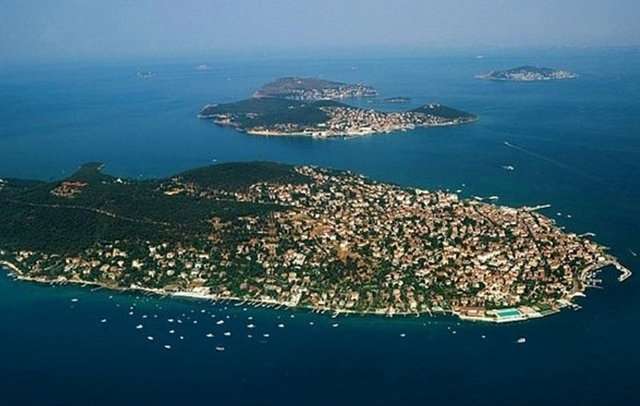
There is little information about the history of the Istanbul Islands before the Byzantines. These are found in the works of ancient writers such as Thimkus Artemiones in Western sources, the Islands are where countless tragedies occur. Byzantine historians speak of these monasteries only from the 8th century onwards. When the Latins arrived in Istanbul (1204), Duke Dandola of Venice provoked the Latins to plunder the Islands. However, the Latins did not attack the Islands. The islands were attacked by Euboea and Crete pirates at 1302’. The arrival of the Turks on the Islands coincides with the period of Byzantine emperor Manuel Paleologos.In 1412’ the naval battle between Musa Celebi and emperor Manuel, near Yassiada, affected the Islands.
about a month and a half before the conquest of Istanbul, during the siege of the city of Fatih Sultan Mehmetin, Baltaoglu Suleyman Bey captured the Islands on 17 April 1453’. Gustav Schlumberger likens the tragic history of the Islands to the history of Caprinine, which he equates to in terms of its natural beauty. It is interesting and striking that Resat Ekrem Coach interprets the tragic history of the Islands. “Adas have rich history ruins with a picturesque nature structure. Every step follows a twenty-century history. The hills covered with pine forests, the valleys decorated with all kinds of wildflowers, the shores of the Marmara waves, the emperors who were once deprived of their crowns and thrones, were not tortured, deprived and they were destroyed in a terrible misery.” Islands, during the Ottoman Empire period 19. Abandoned until mid-century, the legal regulation, which allows foreigners to acquire property with the Tanzimat Edict of 1839, has finally entered the process of rapid development.
for the first time, the French chose the islands as a place for the page, and the settlement of the Turks took place later. Another development that has caused the islands to become increasingly important has been the launch of regular ferry services between the Islands and Istanbul and Kadikoy from 1846’, minorities and foreign nationals have made the Islands a place for a page during this development process. At the end of this development, one of the first three municipal offices established in Istanbul was the Municipality of the Islands, which is called the Seventh Circle. (1861 ) Heybeliada is the Private Rum Men’s High School available today; in the ‘Tedrisat iptidaiye’ law issued in 1913, it relates to the status of private schools. The status of private schools was clarified with the Mekatibi Housiye Instruction published in 1915. The Treaty of Lausanne of July 24, 1923, 40. And 41. With the rights of culture and education granted to minorities in the articles, foreign and private schools continue their work.
founded in 1906, the British “Prinkipo Yacht Club”, after the Republic “Migoday Yacht Club STONE.” In 1937, “Anatolu Club”, which was established in 1926’ on the directive of Ataturk, started to operate as a branch of Anatolian Club, which started its activities in Ankara. The main feature that distinguishes the islands from the other districts of Istanbul is that they do not have a land connection with all of them, they are settled on a summer page. With its rich natural beauty, the pearl of the Marmara and the natural lungs of istanbul, the islands, a page of istanbul, the place of rest and entertainment, is after the beginning of the 20th century. The islands of Istanbul, also known as the Prince Islands, are 9 islands in the sea of Marmara, an hour away from the city.
The ferry or sea buses departing from the Golden Horn entrance and the Kabatas piers make regular flights to the four islands. During the Byzantine period, the islands where monasteries were established had been a summer cottage or a place of exile; copper mines were also used in Hebelide. Again on this island the last structure of Byzantium, the small church dedicated to Mary, is located in the courtyard of the upper building of the Naval High School.!With steam steam steam steam steam steamers that were served at the beginning of 9 years, transportation to the names was facilitated and when schools and hotels were built, population growth began. The large, side by side, four islands are covered with summer houses, villas, pine groves and are famous for beach and picnic areas. The islands, which are crowded from May to the end of September, are secluded at other times. Phaetons are the only means by which the settlements develop in the direction facing the city in the vicinity of the piers, the island roads whose hills are covered with pine. During the season, especially during the holidays, bays and beaches are attractive stops of private yachts and engines, sailing boats. The first sighted conical silhouette of the sea vehicles from the city is the Charitable Island and the second Flat Island is also not inhabited.
the first stop is an open beach around the island and is famous for the bay behind it. Phaetons do not work here except for freight cars. The modern small mosque on the beach is one that draws attention to the old, beautiful mansions. After the shore, the rocky coast and the island of Burgas are located. The first and famous of the Sailing and Water Sports clubs on every island is here. When novelist Sait Faik Abasiyanik lived on the island, his house was turned into a museum and his stop was a famous cafe in Kalpazan Kaya district, famous for its sunset. In the direction of Heybeli, there is a special Island of Spoons, named because of its shape. The Heybeli Ada twin hills include the sea high school upper building, while on the other hill in front, the Rum Ruhban School, which is still not taught in the pine, is the first big buildings seen.
Next to the island scaffold, the Sea High School stretches along the coast. Restaurants and tea houses are in the other direction. With a very nice bay on the back facade of the residential areas, on the side facing the Isle of Spoon there is a public beach and a famous Mill Nose picnic area behind it with its Sea club facilities. On the roads surrounding the hills, beautiful and scenic walking routes run around the island in the pines. The island is also relatively mobile during the winter months due to schools and sanatorium facilities. The year-round Halki Palas Hotel has been in service since the mid-19th century.
It was renovated in 1995 and has all modern facilities. The team is the largest and most famous of the Islands and the Great Island. With the Fayton tour, you can walk around in close to two hours. But a half-turn to an hour is more interesting. Yoruk Ali Beach, in the direction of Heybeli Ada from the public beaches, is located in a magnificent bay.
The tongue-nose next door is a beautiful place preferred by the promenade area.In contrast to the crowded residential area around the pier, the southern side of the island is uninhabited. The bays here are the places of visit of the boats. The 19th-year-old hotel, which is in ruins on the upper backs of the island, is perhaps the largest wooden structure in the world, trying to stand with the longing of the time it will be bestowed. The Great Island scaffolding vicinity is colorful and lively with its restaurants, tea houses and shops. There are 4 hotels serving in the summer. Beautiful houses, well-groomed gardens, unique landscapes leave unforgettable memories for travelers to the islands. Next The island of Sedef is open to those who come outside its inhabitants, with its beach.
The islands are the scene of an intense internal tourism movement, especially in the summer, so the population increases significantly in the summer season. The population increases close to 10 times in summer compared to the winter season, the increase in weekends exceeds this. Houses are mainly used as summer houses (second houses).Section of the built-in population works in Istanbul and commutes to the city on a steamboat.
EXAMPLES OF IMPORTANT BUILDINGS:
Buyukada; Kaymakamlik Building (Hacapulos Pavilion ), Rum Orphanage (Prinkipo Palas), Anatolian Club Building, twin Structures, (Castelli Homes) Splendit Hotel, Guntekin Pavilion, Con Pasha Mansion, Rum, (John Avrimidisin House) Aya Yorgi Manastiri, Agopyan Pavilion, (Cankaya Hotel)
Heybeliada; Deniz High School Preparation Department, Deniz High School, Halki Palas Hotel, Special Rum Men’s High School (Old Ruhban School), Guppinar Pavilion, Inor House (Mavromatis Pavilion), Ahmet Rasim Evi, Turkey,
Burgazadasi; Sait Faik Abasianik Museum, House of Trust (Teachery), Turkey,
Kinaliada; Stoner’s Mansion, Nedurian House.