GTurkiye

Author: tur

  • The Purposes for Usage of the Caves in Turkey

    The formation and development properties and the climatic condition of a cave determines the purpose of usage of that particular cave. The common usage fields of the caves are as follows:

    – Tourism
    – Natural deep freeze deputing
    – Preservation and maturation of animal based products (Water pipe cheese, butter, etc. )
    – Cultural mushroom growth
    – Respiratory system diseases
    – Storage of liquidified gas, natural gas and fuel oil
    – Shelter and refuge for military purposes
    – Guano production
    – Placer mineral inference
    – Determination of underground water basins and taking these water to surface
    – Determination of the pollution focuses of spring waters and preservation methods
    – Determination of regional geological, geomorphologic, hydrological, hydro geological, anthropological and paleo ecological properties.

  • Types of Mountains in Turkey

    Types of Mountains and Important Mountains in Turkey

    Mountains Types in Turkey

    Turkey, which becomes more arid the further south one goes, is presently hemmed in on every side by mountain ranges: The Northern Anatolian Mountain Range, the Interior Anatolian Massif Range, the Southern Anatolian Mountain Range and the Southeastern Anatolian Mountain Range. Important mountains in the Northern Anatolian Mountain Range are Istiranca (Yildiz) Mt. (1000 m), Bursa Uludag Mt. (2543 m) , Bolu Kopoglu Mt. (2400 m), Ilgaz Mt. (2587) and the Karagol Mts. (3100m). In the Central Anatolian Massif Range, there are volcanic mountains such as, Erciyes Mt. (3917m), Hasan Mt. (3263m), Greater Mt. Ararat (5137m), Tendurek Mt. (3533m), Suphan Mt. (4058m) and Nemrut Mt. (3050m). In the folded Taurus Mountain range, there are the Beydaglar Mts. (3086m) and Bolkar Mts. (3524m), and in the Southeastern Anatolian Mountain Range there are the, Hakkari Cilo (Buzul), Sat (4136m) and Nur (Amanos) Mountains.

    Mountains formed by folding or breaking Western Taurus

    – Beydaglari Central Taurus

    – Bolkar Daglari -Aladaglar Munzur Mountains Cilo

    – Sat Mountains Kackar Mountains

    – Western Group (Versembek)

    – Kavran Group

    – Eastern Group (Altiparmak)

    Volcanic Mountains

    – Mount Ararat and Lesser Ararat

    – Mount Suphan

    – Mount Tendurek

    – Mount Nemrut

    – Mount Hasan

    – Mount Erciyes

    Important mountains in Turkey (Ranked according to height)

    Name of the Mountain Height (meters)
    Mt. Ararat 5137
    Suphan 4434
    Gelyansin (Resko Tepesi, Cilo – Sat) 4134
    Kackar (Kackarlar) 3932
    Mt. Erciyes 3916
    Lesser Ararat 3896
    Handeyade (Cilo – Sat) 3794
    Greater Demirkazik (Aladaglar) 3756
    Kisara (Cilo – Sat) 3752
    Kizilkaya (Aladaglar) 3725
    Mazani (Cilo – Sat) 3725
    Emler (Aladaglar) 3723
    Vercenik (Kackarlar) 3711
    Kaldi (Aladaglar) 3688
    Mirhamza ( Cilo – Sat) 3670
    Kizilyar (Aladaglar) 3654
    Gurtepe (Aladaglar) 3630
    Sematepe (Aladaglar) 3623
    cagalin Basi (Aladaglar) 3612
    Torasan (Aladaglar) 3584
    Alaca (Lorut)(Aladaglar) 3582
    Vayvay (Aladaglar) 3563
    Bulut (Kackarlar) 3562
    Boruklu (Aladaglar) 3548
    Gevaruk (Cilo – Sat) 3540
    candir Dagi (Van Golu) 3537
    Gungormez (Kackarlar) 3536
    Sulagankaya (Aladaglar) 3530
    Soganli Dag (Kackarlar) 3527
    Medetsiz (Bolkarlar) 3524
    Direktas (Aladaglar) 3510
    Orta Dag (Aladaglar) 3500
    Karatas (Kackarlar) 3495
    Kesif (Bolkarlar) 3475
    Cebelbasi (Aladaglar) 3474
    Liblin Tepe (Kackarlar) 3472
    Karasay (Aladaglar) 3472
    Guzeller (Aladaglar) 3461
    Siyirmalik (Aladaglar) 3426
    Tearzin (Cilo – Sat) 3415
    Lesser Demirkazik (Aladaglar) 3400
    Tahtakaya (Bolkarlar) 3372
    Didvake (Kackarlar) 3350
    Buyuk Dag Tepe (Kackarlar) 3328
    Sat Basi (Cilo – Sat) 3302
    Altiparmak (Kackarlar) 3301
    Marsis (Kackarlar) 3300
    Kardal (Cilo – Sat) 3300
    Kizlar Sivrisi (Beydaglari) 3069
    Mt. Nemrut 3050
    Uludag 2543
  • Places to See in Foca, Izmir, Turkey

    foca izmir turkiye

    Siren Rocky Place
    It is mentioned in Homeros epic, and described as rocks to where ships that loose their way crashes. It is one of the biggest rocky place, composed of islands which reminds like seal fishes is Orak Island.

    Seytan Hamami (Satan’s Hamam)
    Tomb type structure at the feet of Can peak, is known as Seytan Hamami (Satan’s Hamam). It is 2 km. away from province center.

    Castles

    Bes Kapilar Castle
    This antic castle is given to Manuel Zacharna from Genevese by Michel Paleoloc and its ramparts are repaired by Genevan people within the time. After join of Phokaia to Ottoman land in 1455, the ramparts are repaired and nine of them have been equipped with towers which can be spotted today. The Part, which is used as open air Theater today in Bes Kapilar was “boathouse”. According to the inscription over entrance door, this repair is done in between 1538 – 1539 by Silahtar Iskender Aga, woodsman of the Sultan Mustafa Han, who was Saruhan State Principal in between 1533 and 1541, son of Magnificient Suleyman.

    External Castle Castle
    Referred as “External Castle or Genevese Castle” at “Castle Bay” at south west of Foca, according to the sources, is constructed as a cutthroat by Ottomans on a strategic point to guard the region in 1678. The castle which is on a cape, is separated from the continent via a huge trench with the aim of guarding. During underwater archeological studies, stone shots are found at the bottom of the sea in front of the castle. It is thought that these shots are fired via catapults from castle to enemy ships.

    Mosques

    Fatih Mosque
    It is on the Eski Adliye Sokak within Castle. The mosque is a structure, which had lost its uniqueness while reaching today. In 1455, after the conquest of Foca, it was constructed by Fatih Sultan Mehmet. During its initial construction, it was holding the classical Ottoman architectural style.

    Kayalar Mosque
    It is within castle. Construction date and constructing person not known mosque, is showing all of the characteristics of late period Ottoman architecture style. A formerly added water tank with fountain (sadirvan) is present at the west of the structure.

    Hafiz Suleyman Aga Small Mosque
    Structure, known as Suleyman Aga Mescidi among public, is constructed by Foca Castle Guard, Hamzaoglu Mustafa in 1548. But it is understood from today’s appearance that structure had been variously repaired during latter periods.

    Turkish Baths
    Only two Turkish baths could survive from Ottoman period. Both of them are in the Ataturk District. Turkish bath on the corner of 115 and 116 streets, can be classified as dome at the middle, horizontal heated, double gaped Turkish Bath. Its undressing part is completely demolished. Other Turkish bath in 118 numbered street, is highly damaged. It has a different architecture compared with known Turkish Baths, it is thought that this is constructed later than the other one.

    Tas Ev (Rock House)
    This rocky monument tomb rising at the side of the road 10 km. away from Foca, is half cut. The structure, constructed under Persia impact, in Lycia – Lydia tradition, and dated to the 4th century B. C..

    Sea Fishes
    Friends of sailors of Foca, who did not leave sailors alone during sailors’ struggles against sea for centuries, are sweet seals. Mediterranean seals, whose total number in the world is approximately between 350 and 400, are only living in Turkey, Greece and North – Western African coasts. Some portion of Mediterranean seals are settled in islands surrounding Foca. In spite of increasing tourism and fishing, they are using the caverns, coasts in these islands with the aim of bringing forth juveniles, to bring up their juveniles, to rest and sun themselves.

    Mediterranean seals, whose name is ” Monachus Monachus” in Latin, needs to land, and signs of human on their residential areas annoy them. This specie is one of the 12 mammals who are under the danger of annihilation of its generation on the world. In order to protect Mediterranean seals living in Foca islands, it is forbidden to approach more than 2 miles to islands between Aslanburnu and Deveboynu Cape, and more than 100 meters to Siren Rocky Places and Orak Island, on where seals are seen.
  • Ancient City of Keramos, Milas

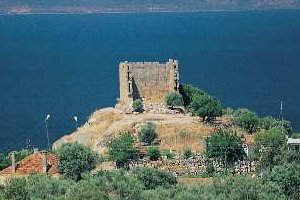
    It is at the today’s oren borough, North coast of Gokova Gulf, and it is 50 km. away from Milas. Defense walls, rock graves at feet of mountain, tombs at necropolis from the city, which took its name Keramos, which means “Pot” or “Ceramic” in Greek language are the important ruins which reached till today. It is one of the most attractive ruin places of tourists, participated to Blue Cruise, made in Gokova Gulf, begun from Bodrum.

  • Ancient City of Herakleia, Milas

    herakleia turkey

    Situated at the head of Latmian Gulf, Herakleia was called Latmus at the beginning taking its name from the impressive mountain reaching the height of 1300 meters above the sea level. Hearclia, which was located at the head of the gulf never, became an important city it was far from the popular trade road running form Ephesus to Miletus. Miletos captured most of the sea borne trade. Although it was located in Ionia, Heralia was a Carian city in character and its history was formed by the events of Caria.

    King Mausolos used a stratagem to capture the city and he changed the name of the city during his efforts of Hellenisation of the Caria region. To differ it from many other Herakleias, it was called Herakleia under Latmus. In 287 BC Lysimachus, one of the generals of Alexander the Great captured the city. He also built great defense walls for the city that still surrounds the town and most impressive remains in the city. These walls, which started at the lakeshore level climb up to 500 meters altitude, extended nearly four miles and fortified with 65 towers.

    Towards the end of the 1 century BC, the prosperity of Herakleia began to decline due to loss of the trade when river Meandros silted up the area and closed the Herakleia’s link with the sea. Second noteworthy monument in Herakleia is the Temple of Athena, situated on a promontory over the beach. This beautiful temple in tem plum in antis dates to Hellenistic period. Herakleia follows Hippodamic style town planning created by the Hippodamus of Miletus. During the Byzantine era, Latmos region attracted great number of monks seeking for the monastic life.

    During the 7th century, monks and anchorites from Arabic lands settled in the caves of Latmus Mountain. Some of these monks became so famous and attracted great number of pilgrims and people to the area. Monastic life at Latmus region lasted for 400 years but ended with the arrival of Turks at the 14th century. The monks returned to the region when Crusaders defeated the Turk at Doryleon 1069. According to a tradition, a monk discovered a cave sanctuary on Mt. Patmos. Discovering also a tomb in it, the monks accepted as the tomb of Endymion and converted the shrine to a Christian holy place.