GTurkiye

Author: tur

  • Islam in Turkey

    Visitors to Turkey are often touched by the call to prayer from lofty minarets. The call is heard five times a day, inviting the faithful to face towards Mecca and pray from the Koran. Although Turkey is a secular democracy which guarantees freedom of religion for all people, Islam is the country’s predominant religion. People of all faiths may visit Turkey’s mosques.

    Islam’s roots in Turkey date to the 10th Century. In the ensuing centuries Seljuk and Ottoman Turks constructed impressive mosques with elegant interior decorations and imposing domes and minarets. Virtually every Turkish city has a mosque of historical or architectural significance. Sultanahmet Mosque in Istanbul stands as perhaps the most impressive. Built between 1609 and 1616 in the classic Ottoman style, the building is more familiarly known as the Blue Mosque because of its magnificent interior paneling of blue and white Iznik tiles. The Suleymaniye Mosque is the largest in Istanbul.

    It was built between 1550 and 1557 by Suleyman the Magnificent, the greatest sultan of the Ottoman Empire. Other cities also have impressive Islamic architecture. The Ulu Cami (Grand Mosque) with its 20 domes and Yesil Cami (Green Mosque) in Bursa, was constructed between 1419 and 1420. The mosque derives its name from the exquisite green and turquoise tiles in its interior. Haci Bayram Mosque in Ankara was built in the early 15th century in the Seljuk style and was subsequently restored by the master Ottoman architect Sinan in the 16th century. Selimiye Mosque in Edirne reflects the classical Ottoman style and Sinan’s lasting genius.

    Konya ranks as one of the great cultural centers of Turkey. As the capital of the Seljuk Turks from the 12th to the 13th centuries Konya was a center of cultural, political and religious growth. During this period, the mystic Mevlana Celaleddin Rumi founded a Sufi Order known in the West as the Whirling Dervishes. Mevlana’s striking green tiled mausoleum is Konya’s most famous attraction. Attached to the mausoleum, the former dervish seminary now serves as a museum housing manuscripts of Mevlana’s works and various artifacts related to the mystic sect.

  • Judaism in Turkey

    Judaism has had a continuous presence in Turkey since ancient times. Signs written in Hebrew and menorahs carved into stone at historical sites such as Ephesus, Kusadasi, Priene, Hieropolis, and Pamukkale attest to long history of Jews in Turkey. In Sardis, near Izmir, the remains of the largest ancient synagogue in existence date to the 3rd century AD. Its frescoes and mosaics suggest a large, well-established and successful Jewish community in Sardis.

    According to the legend of the great flood, Noah’s Ark ran aground at Mount Agri (Ararat). When the floodwaters receded, Noah and his family descended from the mountain to the fertile Igdir Plain and repopulated the world. Jewish Patriarchs Abraham and Job also made their mark in eastern Turkey. Sanli Urfa in southeastern Turkey is known as the city of Prophets. A cave there is said to be the birthplace of the prophet Abraham.

    It has become a place of pilgrimage and is now surrounded by the Halil Rahman Mosque. The Prophet Job, who was famed for his patience, is believed to have spent seven years recovering from illness inside another cave located in the district of Eyyübiye two kilometers south of Sanli Urfa. Jews have enjoyed tolerance and peace in Turkey for centuries. After the Jewish communities in Spain and Portugal were exiled in 1492 during the Inquisition, Sultan Beyazit II welcomed them to the Ottoman Empire. As a result, many Jewish communities still thrive in modern Turkey.

    Istanbul is of particular significance to Jewish visitors. In the city’s old Jewish Quarter is the 19th century Neve Shalom Synagogue, the Zulfaris Jewish Museum and nearby, the 15th century Ahrida Synagogue. The first Jewish printing press began operating in Istanbul in 1493 and Jewish literature and music flourished during this period. In Bursa, a short drive south of Istanbul, visitors will find the Gerus Synagogue, built at the end of the 15th century by the first Jews who settled in the city after being expelled from Spain.

    The name of the synagogue in Hebrew means, "Expelled". Izmir, located on the Aegean coast, has several synagogues, including Beth Israel Synagogue; Bikour Holim Synagogue, named in memory of an epidemic when city hospitals were so full that synagogues were used to house the sick, and Giveret Synagogue, rebuilt after an 1841 fire.

  • Christianity in Turkey

    More and more people are discovering the important role Turkey played in the history of Christianity. Travelers can discover many magnificent churches, some nearly as old as Christianity itself, and can retrace the footsteps of Saints Peter and Paul from the Biblical city of Antioch to the underground churches of Cappadocia. Many of the most important events in Christian history occurred in Turkey.

    Born in Tarsus, the Apostle Paul spread the word of Jesus Christ across Anatolia, expanding Christianity’s reach from a predominantly Jewish base to Gentile communities. Not far from Tarsus on Turkey’s Eastern Mediterranean coast is Antakya, known in biblical times as Antioch. This ancient city was founded around 300 B.C. and was home to the first important Christian community, founded in 42 AD by St. Paul. Jesus’ followers were first called "Christians" in Antioch and from here Christianity spread to the world. St. Paul departed from Antioch on his three missionary journeys.

    The city holds the Church of St. Peter, a cave-church where the apostles Peter and Paul are believed to have preached. In 1963, the Vatican designated the site a place of pilgrimage and recognized it as the world’s first cathedral. The "Seven Churches of Asia Minor," a series of communities located near the Aegean coast, is where St. Paul visited, preached and built the early church. Their ancient names – Ephesus (Efes), Smyrna (Izmir), Thyatira (Akhisar), Sardis (Sart), Philadelphia (Alasehir), Laodicea (Eskihisar) and Pergamon (Bergama) are familiar from the New Testament’s Book of Revelation.

    Ephesus, perhaps the most prominent of the Seven Churches, is where St. Paul wrote his letters to the Ephesians, and where St. John the Evangelist brought the Virgin Mary to spend her last years. The Vatican recognizes the Virgin Mary’s house, located in the hills near Ephesus, as a shrine. Just outside Ephesus, in Selcuk, is the Basilica of St. John where he preached and is believed to be buried. Many other regions in Turkey offer a wealth of attractions to the Christian traveler. St. Nicholas was born and lived in Demre on the Mediterranean coast. A church dedicated to the original Santa Claus still stands.

    Visitors to the biblical area of Cappadocia, located in Central Anatolia, can explore more than 200 carved rock churches beautifully decorated with frescoes depicting early Christian motifs, and a seven story underground city where Christians took refuge from their persecutors. The stunning Monastery of the Virgin Mary located near the Black Sea in Trabzon is a well-known monastic center dating to the 4th century. Built on the edge of a l200 foot cliff and accessible only by foot, it housed some of the Orthodox Church’s greatest thinkers.

    Istanbul became the center of Christianity in 330 AD and it was here that the largest church in Christendom at the time, Haghia Sophia or the Church of the Divine Wisdom, was dedicated by Emperor Justinian in 536 AD. The Kariye Museum, a Greek Orthodox Church from the 11th and 14th centuries, is famous for its incomparable Byzantine frescoes and mosaics.

  • Religions in Turkey

    What attractions does Turkey offer related to religious history and issues of faith?

    History has been incredibly generous to Turkey, which has been vital in the history of the three major Western religions – Judaism, Christianity, and Islam. Turkey is one of a few countries where all three religions have co-existed peacefully for centuries. There are a many important sites in Turkey of interest to people of all faiths.

  • The Seven Churches of The Revelation Apocalypse in Asia Minor

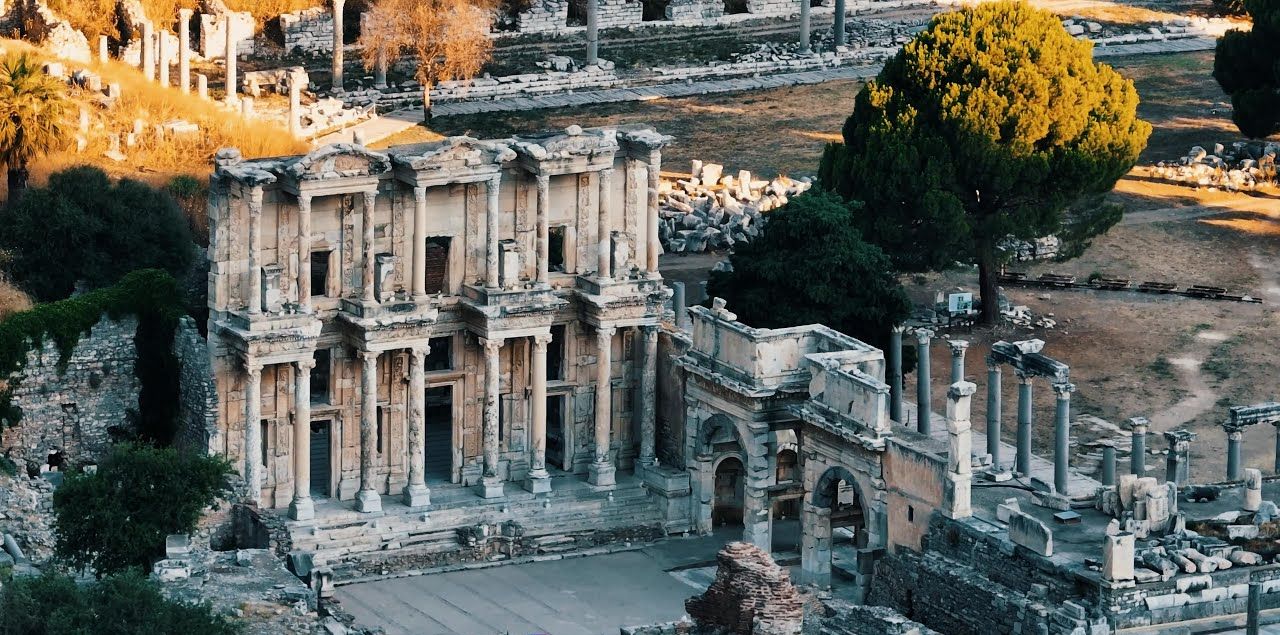
    Ephesus Turkey

    The Seven Churches of the Apocalypse, mentioned by St. John in the Book of Revelations, formed separate and distinct communities, and are all found in Turkey : Izmir (Smyrna), Ephesus, Eskihisar (Laodicea), Alasehir (Philadelphia), Sart (Sardis), Akhisar (Thyatira), and Bergama (Pergamum). Tours of one to four days can be arranged to see several or all of the churches.

    The land known to the Romans as Asia Minor and which now forms the greater part of Turkey is an extraordinary mosaic of culture, history and geography. At the beginning of the year 2000 it seemed appropriate to take a look at an aspect of this historic diversity which contributes to the universal significance of Asia Minor. The last book in the New Testament of the Bible records the revelations of St John, also known as St John of Asia Minor. The Book of Revelation’s main subject is the end of the world, and it relates messages sent by Christ to the seven churches as the apocalypse approaches. All seven of these first Christian churches were situated in what is now Turkey.

    In the Book of Revelation, also known as the Apocalypse of St John, fascinating symbolic images are used. The Jewish symbol of the seven branched candlestick here becomes seven candlesticks representing the seven churches of Asia Minor: ‘The mystery of the seven stars which thou sawest in my right hand, and the seven golden candlesticks. The seven stars are the angels of the seven churches, and the seven candlesticks which thou sawest are the seven churches’ (1:7). Jesus Christ appears to St John and gives messages to each of the angels (priests) of the churches, which are cited in order of their importance as Ephesus (Selcuk), Smyrna (Izmir), Pergamos (Bergama), Thyateira (Akhisar), Sardis (Salihli), Philadelphia (Alasehir), and Laodicea (Goncali).

    The word church as employed here does not refer to a building but to a community of Christians. In the early years Christians were persecuted by Jews and pagans who felt threatened by the new faith, and they were forced to worship secretly in the mountains, in graveyards, and in catacombs. Even in the smallest town of Asia Minor there was no question of converts to the new faith gathering publicly at a church.

    The Apocalypse was written around the year 95, a time when the Emperor Domitian had ordered Christians to be the most fearful tortures punished by. The number of churches is significant, not in itself, but because of the underlying symbolism of the number seven. All religions and traditional beliefs attach significance to particular numbers, such as one, three, four, seven, nine, twelve, thirty-three and forty. The number seven has mystic meaning in many cultures, as illustrated by the seven heavens, the story of the Seven Sleepers, the combination of squares and triangles in the Egyptian pyramids, the seven days of the week and the seven branched candlestick.

    In Rome and its environs anti-Christian feeling was motivated largely by political factors, whereas in Jerusalem and the Holy Land economic factors predominated. Asia Minor, however, although also part of the Roman Empire, was remote from both these areas, and offered relative safety. There were large communities of underprivileged here, and in addition it was a place which had traditionally been home to very mixed ethnic and religious communities which had learnt to coexist in tolerance or at least indifference.

    This combination of conditions meant that the new faith was able to spread more easily in Asia Minor than anywhere else. Now let us travel to the Aegean region to visit the locations of the seven churches, starting with the last mentioned in the Bible. The seventh church was in Laodicea, a city founded in the 3rd century BC by Antiochus II. Its ruins are in the province of Denizli off the road leading to the ruins of Hierapolis at Pamukkale, and close to Goncali train station. At a time when Hierapolis, with its hot mineral springs, was an important spa and its Temple of Apollo a famous oracle, Laodicea was a major centre of trade where the roads from east and south joined and continued to the Aegean coast.

    The existence of a large Jewish community in the city, its remoteness from political centres, and its cosmopolitan character which enabled people of diverse faiths to coexist peacefully made it possible for the early Christians to form a significant community here. The sixth church was in Philadelphia, today’s Alasehir, founded by King Attalos II of Pergamum. Situated on the trade routes between the interior and western coastal region, this city, too, had an important role in transit trade. Sardis, where the fifth church was located, was one of the most important cities of Asia Minor, and the place where the first coins were struck from electron, an alloy of gold and silver, in the 6th century BC. The size of the synagogue and 3rd century BC Temple of Artemis amongst the ruins of this ancient city near the modern town of Salihli clearly indiciate the city’s importance.

    The fourth church was at Thyateira (Akhisar), which was well known for its wool, leather, dyeing and bronze industries. The third church was in the city of Pergamum, alias Pergamos or Pergamon, and known as Bergama today. Other marches by Ida were also published in Europe at this time, such as Cinq Marches Militaires pour Piano, five military marches for the pianoforte published in Paris, and a march which also appeared in The Illustrated London News of 27 May 1854. It was celebrated worldwide for the magnificent library containing 200,000 scrolls which Anthony presented to Cleopatra, for parchment made of goatskin known as ‘Pergamum paper’ used as a substitute for Egyptian papyrus, and for the Aesclepion which was the most advanced medical centre in the ancient world.

    The largest of all Hellenistic theatres stands here and the city’s temples are remarkable for both their size and beauty. Conditions here were ideal and the Christian community flourished. The second church was in Smyrna, today’s Izmir, a major port halfway down the west coast of the Aegean. Throughout history this city never lost the commercial importance deriving from its position. The imposing agora, huge in scale and with two storey galleries rarely seen elsewhere, reflects this vital role in East and West trade. The first of the churches addressed in the Book of Revelation, and the most important of all, was Ephesus.

    This was the second largest city of the Roman Empire, and formed Rome’s link with the East. Imperial buildings like the Temple of Domitian, the Fountain of Trajan and the Temple of Hadrian illustrate the esteem in which it was held by the Roman emperors. The city also possessed possibly the most complex structure of any in the pagan world. It was here that, according to Christian tradition, St John brought the Virgin Mary after the crucifixion of Christ. They settled on the mountain known today as Bulbul Dagi (Mountain of Nightingales), 6 km from Ephesus. The first Christian community began to live in the woods here; close enough to the city for convenience, but far enough away to keep a low profile.

    It was in this great city that the religious leaders of the Byzantine period convened in 431 and acknowledged St Mary as the Mother of God, and here that the first church was built in her name. All the seven churches of Asia Minor referred to in the Bible were fairly close to one another, each one or two days’ journey from the next. Only Ephesus, Pergamum and Smyrna are remembered by most people today, yet although the cities of the seven churches did not play an equal role in history, culture and the development of Christianity, discovering these sites is an evocative spiritual experience. The Seven Churches Of Asia Minor | Article: By Tunca Varis, Photos Izzet Keribar.